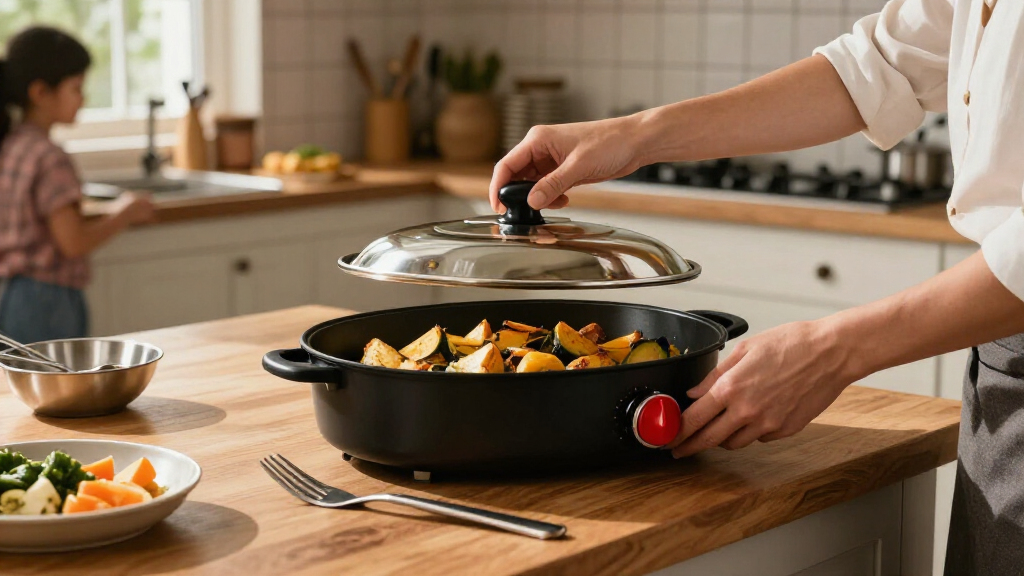
Choosing an electric roasting pan or a conventional oven roasting pan comes down to whether you need another heat source or a better vessel for the oven you already own. An electric model plugs in and cooks on a counter, which can free the oven for side dishes and help when kitchen space is tight. A standard roasting pan has no heating element, but it is easier to store, offers direct oven heat, and is generally the stronger choice when browned surfaces matter.

Get home appliances delivered free with Prime
- Fast, free delivery on millions of items
- Prime Video, Amazon Music and more included
- Member-only deals all year

28 Quart Electric Roaster Oven with Self-Basting Lid
- ✔ Capacity: 28 quarts
- ✔ Temperature range: 150–450°F
- ✔ Wattage: 1450 watts

SUNVIVI 24-Quart Electric Roaster Oven with 3 Buffet Trays
- ✔ Capacity: 24 quarts
- ✔ Turkey capacity: Up to 28 lbs
- ✔ Temperature range: 150–450°F
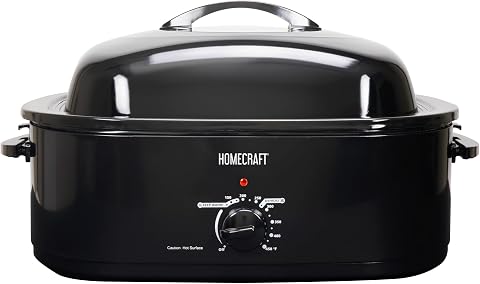
Homecraft 18-Quart Electric Roaster Oven
- ✔ Capacity: 18 quarts
- ✔ Maximum temperature: 450°F
- ✔ Control: Full-range dial; listing also states three settings
The difference is most useful during large meals: the electric pan gives you extra cooking capacity and portability, while the oven pan asks less of your storage and usually gives you more control over roasting and browning. Choose electric if oven space is the bottleneck and a large countertop appliance is practical. Choose a conventional pan if you want a versatile roasting vessel for an oven you already have, especially for crisp-skinned poultry or pan sauces.
At a Glance
| Criteria | Electric Roasting Pan | Oven Roasting Pan | Winner |
|---|---|---|---|
| Heat source and setup | Self-heating countertop appliance; needs an outlet and a suitable surface | A pan used inside a conventional oven; no separate power source | Depends |
| Oven-space relief | Frees the main oven for other dishes | Uses the oven, so it does not add cooking capacity | A |
| Browning and crispness | Often less effective at browning and crisping than a conventional oven | Usually better suited to dry roasting and browning in oven heat | B |
| Capacity and fit | Available in large sizes, but counter space and usable interior dimensions vary | Many sizes and shapes; must fit both the oven and the food | A |
| Temperature control | Thermostat-based control; behavior varies by model | Depends on the oven, with no separate appliance thermostat | Depends |
| Storage and portability | Bulky to store, but can be moved and used away from the oven | Usually simpler to store; portability is limited to moving the pan and food | B |
| Versatility and cleanup | Can roast and hold food warm; removable inserts simplify some cleanup | Useful for roasting and often pan gravies; cleanup depends on material and design | B |
| Value | Worth the added cost when separate cooking capacity is regularly useful | Usually lower-cost and better value for occasional roasting | Depends |
28 Quart Electric Roaster Oven with Self-Basting Lid
For buyers who want one appliance to cover substantial roasts as well as warming and defrosting, the Kiss the Water 28-quart roaster has the broadest feature mix here. Its 150–450°F dial range and dedicated warm and defrost functions make it adaptable to more than the roasting stage. The viewing window lets us check food without lifting the lid, while the self-basting design is intended to circulate moisture and drippings. Those details distinguish it from Homecraft, whose listing offers a high-dome lid but no viewing window or self-basting feature.Capacity is also its main drawback. At 27 inches deep and 22 inches wide, it has the largest stated footprint in this lineup, so we would measure both the counter and storage space before choosing it. The 14.7-pound listed weight is manageable to move for some kitchens, but the dimensions still make it a poor fit for tight cupboards. Its knob is straightforward, though cooks seeking precise digital adjustments will find less information and control detail here than they may want. Compared with SUNVIVI, Kiss the Water prioritizes the main roast and lid visibility over built-in buffet serving.The removable pan and rack simplify separating components for cleanup, and anti-scald handles are a practical handling detail. This pick makes the most sense when we regularly cook for a crowd and value checking progress without disturbing the lid. If our meals are smaller or counter space is scarce, Homecraft is the more restrained choice; if keeping sides warm is central, SUNVIVI is better equipped.
Pros:
- 28-quart capacity for large meals
- Viewing window and self-basting lid
- 150–450°F range plus warm and defrost functions
- Removable pan and rack with anti-scald handles
Cons:
- Large 27-by-22-inch footprint needs substantial counter and storage room
- Knob control offers less precision than a digital interface
Best for: Households preparing large roasts that want a viewing window, self-basting lid, and warm or defrost functions.
Not ideal for: Small kitchens, occasional small-batch cooks, or buyers who want digital temperature adjustments.
Bottom line: We recommend Kiss the Water as the most versatile large roaster here, as long as its footprint fits your kitchen.
“We recommend Kiss the Water as the most versatile large roaster here, as long as its footprint fits your kitchen.”
SUNVIVI 24-Quart Electric Roaster Oven with 3 Buffet Trays
When the challenge is keeping sides ready alongside the roast, SUNVIVI’s three buffet trays give it a role the other two models do not fill. We can use the trays to hold side dishes warm while the main course cooks, which makes this 24-quart model the clearest fit for a meal that moves from roasting to serving. Its listed capacity is between Kiss the Water’s 28 quarts and Homecraft’s 18, so it offers a middle ground for cooks who want room for a substantial centerpiece without choosing the largest roaster.The 150–450°F control range and self-basting dome lid resemble the core roasting features of Kiss the Water. SUNVIVI also includes a divider pan and lift-out rack, and its removable pan and buffet trays are described as dishwasher safe. That cleanup detail is useful when a busy meal creates several serving pieces to wash. Its listed dimensions are 12 inches deep by 25 inches wide by 17 inches high, so we should check counter space carefully; the broad width remains a consideration even though the listed depth is less than Kiss the Water’s.The serving setup comes with a real spatial tradeoff: trays and divider reduce interior room when used in the roaster. Buyers who mainly want a large, unobstructed roasting pan may prefer Kiss the Water, whose larger capacity is not paired with buffet accessories. Homecraft is simpler and smaller, but lacks SUNVIVI’s serving pieces. We would choose this model when keeping multiple sides warm is part of the plan, and skip it if those accessories would spend most of their time in a cupboard.
Pros:
- Three buffet trays support serving several warm sides
- 24-quart capacity fits between the other two models
- Self-basting dome lid and 150–450°F range
- Removable pan and buffet trays are listed as dishwasher safe
Cons:
- Buffet trays and divider pan use interior space during roasting
- 25-inch listed width still requires a broad storage area
Best for: Hosts who want to keep several side dishes warm alongside a roast and value removable serving pieces.
Not ideal for: Cooks who need the roaster’s full interior capacity for the main dish or have limited width for storage.
Bottom line: SUNVIVI is the strongest match for buffet-style meals, provided you can spare the room its trays and wide body require.
“SUNVIVI is the strongest match for buffet-style meals, provided you can spare the room its trays and wide body require.”
Homecraft 18-Quart Electric Roaster Oven
Homecraft’s 18-quart capacity makes it the most compact choice by listed dimensions among these three. At 23.43 inches deep, 15.35 inches wide, and 12.21 inches high, it is appreciably narrower than either Kiss the Water or SUNVIVI. That can matter more than an extra few quarts if we have limited storage or usually cook for a smaller group. Its high-dome lid, removable enamel pot, and stainless-steel lift-out rack cover the basic needs of roasting a turkey, chicken, or pot roast without adding buffet trays to store.Homecraft reaches 450°F and is described for roasting, slow cooking, thawing, and warming. It therefore shares broad cooking modes with the larger picks, but does not list the same 150°F minimum or self-basting lid as Kiss the Water and SUNVIVI. Its simpler setup is a strength for buyers who do not need a window or side-dish station, but less compelling for cooks who host large gatherings and want more built-in versatility.There is a notable ambiguity in the supplied control information: it calls the temperature control a full-range dial while also listing three settings. We would not assume fine-grained adjustment without confirming how the dial works. The cool-touch handles and removable pot help with handling and cleanup, while five-year spare-part availability is a useful ownership detail. Compared with SUNVIVI, this model gives up buffet serving features; compared with Kiss the Water, it gives up capacity and the viewing window. In return, it has the least demanding listed footprint.
Pros:
- Smallest listed width and overall dimensions in this comparison
- Removable enamel pot and stainless-steel lift-out rack
- Cool-touch handles and high-dome lid
- Spare parts listed as available for five years
Cons:
- 18-quart capacity is smaller than both alternatives
- Control description is unclear about whether the dial offers full-range adjustment or three settings
Best for: Smaller households and storage-conscious cooks who want an electric roaster with a removable pot and rack.
Not ideal for: Large gatherings, buffet-style service, or buyers who require clearly specified fine temperature increments.
Bottom line: Homecraft is the practical space-conscious option, but the smaller capacity and ambiguous control description make it less suitable for demanding large roasts.
“Homecraft is the practical space-conscious option, but the smaller capacity and ambiguous control description make it less suitable for demanding large roasts.”
As an Amazon Associate we earn from qualifying purchases.
Key Differences
The electric pan’s clearest advantage is capacity outside the oven. If the oven is full of casseroles, vegetables, or baked goods, a countertop roaster can handle a main dish independently. That can make holiday cooking easier and lets the appliance travel to a gathering with a usable outlet and stable surface. The benefit depends on having counter space, checking the roaster’s actual interior dimensions, and accepting another large item to store.
The conventional pan is the straightforward choice for cooks who want roasting performance without adding an appliance. It relies on the oven’s heat and generally works better for browning and crisping, though results still depend on the pan, recipe, oven, and food placement. Its value is strongest when oven space is available and roasting is occasional. Paying more for electric capacity makes sense for frequent large meals or a second cooking location; otherwise the extra function can become an expensive, bulky substitute for a pan that fits the existing oven.
Detailed Comparison
Heat source and setup (moderate difference)
The electric roaster heats itself on a countertop, so it needs a nearby outlet, clearance, and a stable heat-safe surface. The oven roasting pan simply goes into the oven and adds no appliance setup. Neither is universally easier: electric wins when the oven is occupied or unavailable, while the conventional pan wins when the oven is ready and you want fewer separate devices. The gap is moderate because setup changes the cooking location, not just the pan.
Oven-space relief (Electric Roasting Pan wins — major)
The electric roaster wins clearly because it cooks independently and leaves the oven available for other dishes. A conventional roasting pan uses the oven and cannot relieve that bottleneck. For a holiday meal with several dishes competing for rack space, that is a major practical advantage. For a normal dinner with an available oven, the added capacity may have little value.
Browning and crispness (Oven Roasting Pan wins — moderate)
The oven roasting pan is usually the better choice for dry roasting, browned surfaces, and crisp poultry skin because it uses the oven’s heat and airflow. Electric roasters can cook large cuts effectively, but their enclosed design and heating patterns may produce less even browning; model results vary. This is a moderate-to-major difference if appearance and crispness matter. A cook using an electric roaster may need to check the manual and recipe for browning techniques rather than assume the result will match oven roasting.
Capacity and fit (Electric Roasting Pan wins — moderate)
Electric roasters are often marketed for large meals, and their separate footprint lets them add cooking capacity. Still, stated capacity does not tell the whole story: confirm the interior dimensions, lid clearance, and the size of the food. A conventional pan comes in many sizes but must fit both the oven cavity and the roast. Electric has the advantage for adding a second cooking space, while the conventional pan may fit better in a kitchen with limited counters. The difference is moderate and depends on the specific kitchen and model.
Temperature control (minor difference)
An electric roaster has its own thermostat, which makes it independent of the main oven’s controls, but thermostat accuracy and heat distribution differ by model. A conventional pan depends on the oven’s temperature behavior. Neither automatically guarantees precise cooking: use an appropriate food thermometer for doneness. This is a minor-to-moderate difference; the separate control is useful when the oven is occupied, but it is not a substitute for checking the food.
Storage and portability (Oven Roasting Pan wins — moderate)
The oven pan usually wins on storage because it has no heating base or controls and can often nest with other cookware. The electric roaster is bulkier, yet it can be carried to another kitchen or event and run wherever a suitable outlet is available. For a small home, the storage penalty can outweigh occasional portability. For a host who regularly cooks away from home, the appliance’s portability is a real benefit. Overall, the conventional pan has a moderate advantage for everyday storage.
Versatility and cleanup (Oven Roasting Pan wins — minor)
A conventional roasting pan is more useful beyond roasting when its material and construction suit the stovetop for making pan gravy, and it can also serve as general oven cookware. Many electric roasters roast and hold food warm, but their heating base is dedicated to the appliance and can limit other uses. Cleanup varies: removable inserts can help with an electric unit, while a heavy oven pan may be awkward to wash. The conventional pan wins modestly on broad kitchen use; check product instructions before using either pan on a stovetop.
Value (major difference)
The oven roasting pan is usually the better value for occasional cooks because it costs less than a dedicated appliance and does the core roasting job in an oven most kitchens already have. An electric roaster earns its added cost when it is used regularly to free oven space, cook in a second location, or keep food warm according to the model’s instructions. The premium buys capacity and convenience, not automatically better browning. This is a major difference for a buyer who will use the appliance only once or twice a year.
Electric Roasting Pan: Pros and Cons
Pros:
- Adds a separate cooking space and frees the oven for other dishes
- Can be moved to a gathering where a suitable outlet and surface are available
- Many models can keep food warm, subject to the manufacturer’s directions
Cons:
- Takes substantial storage and counter space
- May brown or crisp less effectively than a conventional oven
- Costs more and adds another appliance to clean and maintain
Oven Roasting Pan: Pros and Cons
Pros:
- Usually costs less and stores more easily
- Generally better suited to browned surfaces and crisp roasting
- Can be versatile cookware, including for pan gravy when its construction allows
Cons:
- Uses oven space and does not add a second cooking location
- Must fit both the oven and the food being roasted
- Offers no independent heating or thermostat
Who Should Choose What
Choose Electric Roasting Pan if:
- Your oven is regularly full during holiday meals or large gatherings.
- You often cook a roast at a second location with access to a suitable outlet.
- You will use independent cooking capacity often enough to justify the appliance’s cost and storage space.
Choose Oven Roasting Pan if:
- You roast occasionally and have an oven with enough room.
- Browning, crisp skin, and the option to make pan gravy matter to you.
- You prefer lower cost, easier storage, and cookware that can serve more than one purpose.
Skip both if: Neither is a fit if you rarely roast large foods, have no room for an electric appliance, and do not need a dedicated roasting pan; a smaller oven-safe dish may be sufficient.
Value for Money
For most occasional cooks, the conventional oven roasting pan is the better value: it performs the basic job for less and avoids the storage burden of a countertop appliance. Paying more for an electric roaster is justified when it solves a recurring space problem, supports cooking away from home, or supplies useful warming capacity. If those needs occur only once a year, renting, borrowing, or rearranging oven timing may make more sense than buying a large appliance. Compare the exact usable capacity and cleanup requirements before paying a premium.
Final Verdict
Choose the oven roasting pan if you already have a workable oven and care most about browning, versatility, straightforward storage, and cost. It is the stronger default for most households. Choose the electric roasting pan if oven space is routinely scarce or you need a portable, independent cooker for large meals. The deciding factor is whether separate cooking capacity solves a frequent problem: if it does, the extra cost and storage can be worthwhile; if it does not, the conventional pan is the smarter buy.
Frequently Asked Questions
Can an electric roaster replace a conventional oven roasting pan?
It can handle many roasting tasks, but it is not a complete replacement if you rely on strong browning, use the pan for stovetop gravy, or want cookware that fits your existing oven routine. Check the appliance’s capacity and instructions for the foods you plan to cook.
Which option is better for roasting a turkey?
Either can cook a turkey if the bird fits and the equipment is used according to its instructions. An electric roaster frees the oven for sides, while a conventional oven roasting pan is generally the better bet for browned, crisp skin. Check the turkey’s fit and use a food thermometer to determine doneness.
Is an electric roasting pan worth the higher cost?
It is worth paying more when you regularly need extra cooking capacity, cook at a second location, or use its warming function. For occasional roasting with an available oven, a conventional pan usually offers better value.
Do electric roasters brown food as well as ovens?
Often they brown less evenly or less strongly, though performance varies by model and recipe. If crisp skin or a deeply browned surface is a priority, a conventional oven roasting pan is usually the safer choice.