

Energy monitoring smart plugs turn any ordinary outlet into a window on your electricity use, showing exactly how much that old fridge, space heater, or gaming rig costs you each month. After comparing eleven leading options, the Kasa KP125MP2 Matter Smart Plug stands out as the best overall pick for its accurate energy tracking, Matter support, and reliable app experience. The Emporia 4-Pack is the strongest choice if your main goal is whole-home energy analysis, while the THIRDREALITY Gen3 is the go-to for Zigbee ecosystems like Home Assistant and SmartThings. The main tradeoffs in this category come down to ecosystem compatibility (Wi-Fi vs. Zigbee vs. Matter), app data quality, and whether you need fast local control or rich cloud-based dashboards. Read on for the full breakdown of each plug, who each one suits, and which ones are worth skipping.

Get home appliances delivered free — and shop member deals
- Fast, free delivery on millions of items
- Access to Prime Big Deal Days deals on October 6–7
- Prime Video, Amazon Music and more included
Complete the kit


Key Takeaways
- Matter compatibility is the biggest differentiator in 2026: the Kasa KP125MP2, Tapo P110M, SONOFF S61s, and Kasa KP125MP4 all work across Apple Home, Google Home, and Alexa, while Wi-Fi-only plugs like the KP115 and P115 lock you into a single ecosystem.
- Emporia‘s plug is the only option in this lineup that feeds data into a full home-energy platform, making it the clear pick for buyers chasing savings rather than automation.
- Zigbee plugs like the THIRDREALITY Gen3 need a hub but reward you with a mesh network that doubles as a signal repeater — something no Wi-Fi plug in this comparison offers.
- 4-pack pricing hides real quality differences: several budget 4-packs in this roundup trade away app polish and calibration accuracy, which undermines the entire point of energy monitoring.
- TP-Link‘s Kasa and Tapo brands dominate the top of the ranking because their apps present historical consumption and cost estimates more clearly than any competitor here.


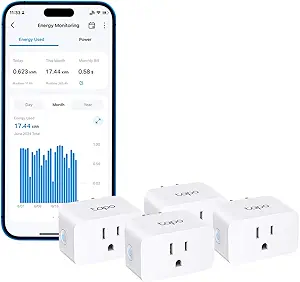


| energy monitoring smart plug | Connectivity | Model | Pack size | Brand |
|---|---|---|---|---|
| Govee Smart Plug with Energy M | Wi-Fi and Bluetooth | — | 4 plugs | — |
| Kasa Matter Smart Plug with En | — | KP125MP2 | — | — |
| Tapo P110M Matter-Compatible S | — | P110M | 4 plugs | Tapo |
| Kasa Smart Plug Mini with Ener | 2.4GHz Wi-Fi | KP115 | — | Kasa |
| SONOFF S61s Matter Smart Plug | Matter over Wi-Fi, 2.4GHz | S61s | — | SONOFF |
| Tapo P115 Wi-Fi Smart Plug wit | Wi-Fi | P115 | 4 plugs | Tapo |
| Emporia Energy Monitoring Smar | 2.4 GHz Wi-Fi | — | 4 plugs | Emporia |
| TP-Link Tapo P115 Wi-Fi Smart | Wi-Fi | Tapo P115 | 2 plugs | — |
| Smart Plug Outlet with Energy | 2.4 GHz Wi-Fi | — | 4 plugs | — |
| Kasa Matter Smart Plug with En | — | Kasa KP125MP4 | — | — |
| THIRDREALITY Smart Plug Gen3 4 | Zigbee 3.0 (hub required) | Smart Plug Gen3 | 4 plugs | THIRDREALITY |
More Details on Our Top Picks
Govee Smart Plug with Energy Monitoring, Wi-Fi and Bluetooth, 4-Pack
For buyers who want to instrument several appliances at once without spending much, this Govee 4-pack makes the most sense. Unlike the Kasa KP115, which is sold individually, Govee lets you blanket a whole room — a fridge, a dehumidifier, a TV, and a space heater — and compare their draw side by side. The Bluetooth-assisted setup is a genuine quality-of-life upgrade over Wi-Fi-only plugs, typically making pairing faster and less error-prone. The app displays real-time power, current, and voltage plus a year of history, which is more granular data than many budget rivals offer. The tradeoff is ecosystem depth: there’s no Matter support here, so unlike the Tapo P110M, it won’t slot into Apple Home or SmartThings, and it locks you to the Govee Home app.
Pros:- Four plugs for the price of one, ideal for whole-room energy auditing
- Real-time power, current, and voltage readings with up to one year of history
- Bluetooth pairing simplifies initial setup compared to Wi-Fi-only rivals
- ETL certified with fire-resistant housing
Cons:- No Matter support, limiting compatibility to Alexa and Google
- 2.4GHz-only Wi-Fi won’t connect to 5GHz-only networks
- Locked into the Govee Home app with no local control option
Best for: Budget-conscious households that want to monitor energy across four or more appliances at once and already use Alexa or Google
Not ideal for: Apple Home or SmartThings users — the lack of Matter support means these plugs live outside those ecosystems
- Pack size:4 plugs
- Connectivity:Wi-Fi and Bluetooth
- Wi-Fi compatibility:2.4GHz only (no 5GHz)
- Voice assistants:Amazon Alexa, Google Assistant
- Energy monitoring:Power, current, voltage; history up to 1 year
- Max load:15A / 120V
- Certifications:FCC, ETL
Our verdict“This pick suits multi-device energy monitoring on a budget, provided you’re content with the Govee app and an Alexa or Google setup.”
Kasa Matter Smart Plug with Energy Monitoring, KP125MP2
If I had to point to a single plug that balances ecosystem flexibility, reliability, and energy tracking, the Kasa KP125MP2 is the one. Its Matter certification means it works natively with Apple Home, Alexa, Google Home, and SmartThings — a level of platform neutrality the Govee 4-pack can’t match. What sets it apart from nearly everything else here is local-network control during internet outages: when your connection drops, your schedules and on/off commands keep working rather than bricking until the cloud returns. The compact housing also leaves neighboring outlets free, unlike bulkier options such as the SONOFF S61s. The compromises are real, though — local control only works if you’ve configured a Matter-compatible hub or controller, and the energy reporting interface is less detailed than Govee’s voltage-and-current breakdown.
Pros:- Matter support across Apple Home, Alexa, Google Home, and SmartThings
- Local-network control keeps automations running during internet outages
- UL-certified flame-retardant build with a 2-year warranty
- Compact design preserves access to adjacent outlets
Cons:- Local control requires a configured Matter-compatible network
- Energy reporting is less granular than Govee’s voltage and current data
- Sold in smaller packs, making whole-home coverage pricier than the 4-packs
Best for: Smart home enthusiasts who want one plug that works across every major platform and keeps functioning during internet outages
Not ideal for: Buyers without a Matter hub or controller — the headline local-control feature requires that infrastructure to function
- Model:KP125MP2
- Compatibility:Matter, Apple Home, Amazon Alexa, Google Home, Samsung SmartThings
- Max current:15A
- Max power:1800W
- Energy monitoring:Yes, tracks usage over time
- Local network control:Yes
- Safety certification:UL-certified flame-retardant design
- Warranty:2-year limited
Our verdict“The strongest all-around choice for buyers who want cross-platform compatibility and resilience, especially those already invested in a Matter setup.”
Tapo P110M Matter-Compatible Smart Plug with Energy Monitoring, 4-Pack, 15A
The Tapo P110M 4-pack is the option for buyers who see energy monitoring as an ongoing habit rather than a one-time curiosity. Its standout feature is energy bill estimation — it converts tracked usage into projected costs, something neither the Kasa KP115 nor the Govee plugs do as directly. Combined with overcharge and overcurrent protection, it’s a good fit for devices that sit plugged in long-term, like phones and laptops, where slow battery damage matters. Compared with the Kasa KP125MP2, you get Matter compatibility across four plugs instead of two, though you give up local control during outages — Tapo’s advanced features route through the app and cloud. The upfront commitment is also larger: if you only need to monitor a single appliance, this pack is overkill and the KP115 is the smarter buy.
Pros:- Bill estimation translates kilowatt-hours into predicted costs
- Overcharge and overcurrent protection safeguards long-term device charging
- Matter certification works with all four major smart home platforms
- Four plugs enable room-by-room comparison in one purchase
Cons:- Advanced energy and scheduling features require app setup and cloud dependency
- No local control during internet outages unlike the Kasa KP125MP2
- Four-pack format wastes money for single-device monitoring
Best for: Households planning a multi-room energy audit who want cost projections, not just raw usage data
Not ideal for: Anyone monitoring just one appliance — a 4-pack is more hardware and cost than the job needs
- Brand:Tapo
- Model:P110M
- Pack size:4 plugs
- Smart home compatibility:Matter, Amazon Alexa, Apple HomeKit, Google Home, Samsung SmartThings
- Control method:Tapo app, voice control
- Features:Energy monitoring, bill estimation, scheduling, overcharge prevention
- Max load:15A
Our verdict“Best for multi-device energy management with cost forecasting, provided you don’t need offline resilience.”
Kasa Smart Plug Mini with Energy Monitoring, KP115
Not everyone needs four plugs — sometimes the goal is answering one question, like how much does that old chest freezer actually cost me? The Kasa KP115 is built for exactly that. Its low-friction Kasa app is widely regarded as one of the easiest setup experiences in the category, making it a strong entry point for smart-home newcomers who would find the Matter configuration of the KP125MP2 or Tapo P110M intimidating. The mini housing stays clear of neighboring outlets, and the safety story goes beyond the norm with overheating protection, a fireproof shell, and a sliding safety cover — the last one being rare among competitors and useful in homes with curious children. The catch is age: no Matter support and no Apple Home compatibility, so ecosystem-minded buyers should step up to the KP125MP2 instead.
Pros:- Kasa app offers one of the simplest setup experiences in the category
- Sliding safety cover protects children from exposed outlet slots
- Overheating protection and fireproof shell exceed typical safety features
- Compact size won’t block adjacent outlets
Cons:- No Matter or Apple Home support, limiting long-term ecosystem flexibility
- 2.4GHz-only connectivity excludes newer 5GHz-only networks
- Buying multiples individually costs more than the 4-pack alternatives
Best for: First-time smart plug buyers who want to monitor one appliance with the simplest possible setup
Not ideal for: Apple Home users and Matter-first households — this plug supports only Alexa and Google
- Brand:Kasa
- Model:KP115
- Connectivity:2.4GHz Wi-Fi
- Voice assistants:Alexa, Google Assistant
- Features:Energy monitoring, remote app control
- Safety features:Overheating protection, fireproof shell, sliding safety cover
- Certification:UL Certified
- Warranty:2-year
Our verdict“The easiest way for a beginner to start tracking a single appliance’s energy use, as long as Alexa or Google is your platform.”
SONOFF S61s Matter Smart Plug, 15A Wi-Fi Outlet with Energy Monitoring, 4-Pack
Where the SONOFF S61s differentiates itself is its focus on electricity cost tracking — it doesn’t just log consumption like the Govee plugs, it converts usage into what you’re actually paying. For someone hunting down the appliance inflating their monthly bill, that framing is more actionable than raw wattage graphs. It matches the Tapo P110M on Matter compatibility and 4-pack quantity, handling 15A loads for heaters and other power-hungry gear, and it needs no hub for direct 2.4GHz setup. The tradeoff sits in the software: the eWeLink app is less polished than Kasa or Tapo’s apps, and energy tracking depends on that app or a Matter controller — abandon eWeLink and you lose the cost data. Physical dimensions are also chunkier than the KP125MP2, so tight power strips may get crowded.
Pros:- Direct electricity cost tracking turns usage data into billing insight
- Matter support across Apple Home, Alexa, Google Home, and SmartThings
- 15A/1875W rating handles heaters and other high-draw appliances
- No hub required with straightforward 2.4GHz setup
Cons:- eWeLink app is less refined than Kasa or Tapo alternatives
- Energy tracking is lost if you move away from eWeLink or a Matter controller
- 2.4GHz-only setup excludes 5GHz-only networks
Best for: Tinkerers and budget-minded buyers who want dollar-denominated cost tracking across four outlets and use Apple, Alexa, Google, or SmartThings
Not ideal for: Buyers who prioritize app polish — eWeLink is rougher around the edges than Kasa or Tapo software
- Brand:SONOFF
- Model:S61s
- Pack quantity:4-pack
- Operating voltage:120V
- Max wattage:1875W (15A)
- Connectivity:Matter over Wi-Fi, 2.4GHz
- Compatible platforms:Apple Home, Alexa, Google Home, SmartThings
- App:eWeLink
- Safety features:Overload protection, fire-resistant housing, ETL Listed
Our verdict“A solid four-outlet option for buyers who want energy data expressed in actual dollars, if they can tolerate a clunkier app.”
Tapo P115 Wi-Fi Smart Plug with Energy Monitoring, 4-Pack, 15A
Four plugs with full energy tracking makes this the sensible pick if the goal is outfitting several rooms at once rather than buying one plug to trial. The Tapo P115 pairs detailed usage charts with cost estimation, so buyers can see which appliances actually drain money, and the smart charging cutoff is a genuinely useful touch for phones and e-bikes that the Emporia 4-pack lacks. Compared with the generic SmartLife 4-pack, the Tapo app is more polished and setup is less fiddly. The tradeoff: cost projections depend on manually entering utility rates, so the numbers are estimates rather than bill-accurate figures. Compared with the Kasa KP125MP4, it skips Matter certification, so Apple Home users are left out entirely.
Pros:- Detailed energy statistics and cost estimation charts help pinpoint power-hungry devices
- Smart charging cutoff and overload auto-shutoff add safety and efficiency
- Mature Tapo app with reliable remote control and scheduling
- 15A rating handles heavier appliances than 10A competitors
Cons:- Cost estimates require manual billing setup and may not match actual utility bills
- No Matter support, locking out Apple Home and SmartThings users
Best for: Households wanting to monitor energy across multiple rooms with a mature, well-supported app
Not ideal for: Apple Home users — this plug only works with Alexa and Google Assistant, not Matter or HomeKit
- Brand:Tapo
- Model:P115
- Pack Size:4 plugs
- Connectivity:Wi-Fi
- Energy Monitoring:Yes
- Voice Assistants:Alexa, Google Assistant
- Max Current:15A
- Special Features:Energy tracking, scheduling, smart charging, overload auto-shutoff
Our verdict“The most practical way to bring energy monitoring to four outlets at once, as long as your smart home runs on Alexa or Google.”
Emporia Energy Monitoring Smart Plug, 4-Pack
These plugs make the most sense as companions to an Emporia whole-home energy monitor, where they slot into the same app and let buyers see plug-level usage alongside their main panel data — something no other option here can do. Standalone, they cover the basics: remote control, scheduling, and per-device energy tracking with Alexa and Google support. But the limits show up fast. A 10A continuous load cap means no space heaters, and it trails the 15A rating of both the Tapo P115 4-pack and the SmartLife 4-pack. The 2.4 GHz-only connection is common at this tier, but buyers on mesh networks that force 5 GHz band steering may fight the setup process.
Pros:- Integrates directly with the Emporia app alongside whole-home energy monitoring hardware
- Multiple control methods including touch and push button, not just app and voice
- Wide operating temperature range from 14°F to 140°F for garages and outbuildings
- Alexa and Google Assistant support with scheduling
Cons:- 10A/1200W limit is lower than the 15A standard most competitors offer
- No 5 GHz Wi-Fi support complicates setup on modern mesh routers
Best for: Emporia Vue owners who want plug-level data unified inside one energy dashboard
Not ideal for: Anyone running high-wattage appliances — the 10A/1200W ceiling rules out heaters and most kitchen gear
- Brand:Emporia
- Pack Size:4 plugs
- Operating Voltage:120V
- Max Wattage:1200W
- Connectivity:2.4 GHz Wi-Fi
- Compatible Assistants:Amazon Alexa, Google Assistant
- Control Methods:App, remote, touch, voice, push button
- Operating Temperature:14°F to 140°F
Our verdict“Buy these if you already own an Emporia system; skip them if you need full 15A capacity anywhere in the house.”
TP-Link Tapo P115 Wi-Fi Smart Plug with Energy Monitoring, 2-Pack
Not everyone needs four plugs on day one, and this 2-pack is the low-commitment way into the Tapo ecosystem. Buyers get the same energy charts, scheduling, smart charging, and overload protection as the Tapo P115 4-pack — just in a smaller bundle that suits a first experiment with, say, a dehumidifier and a TV. Compared with the Govee 4-pack elsewhere in this roundup, the smaller count is offset by stronger app depth and safety features like configurable auto-shutoff. The honest tradeoff is value: per-plug, buying two instead of four costs more, and serious multi-room monitoring will outgrow this set quickly. Cost visualization also depends on billing integration, so treat the money figures as directional, not exact.
Pros:- Same full feature set as the 4-pack, including energy charts and smart charging cutoff
- Overload auto-shutoff adds protection the basic Govee plugs don’t offer
- Lower upfront commitment for testing the waters
- Reliable Tapo app with Alexa and Google Assistant support
Cons:- Higher cost per plug than buying the 4-pack version
- Energy cost figures depend on billing integration and aren’t guaranteed accurate
Best for: First-time smart plug buyers testing energy monitoring on one or two devices before committing
Not ideal for: Buyers already planning whole-home coverage — the 4-pack version is the better per-plug value
- Model:Tapo P115
- Pack Size:2 plugs
- Connectivity:Wi-Fi
- Energy Monitoring:Yes
- Voice Assistants:Amazon Alexa, Google Assistant
- Max Current:15A
- Features:Scheduling, smart charging, overload auto-shutoff
Our verdict“The right entry point if you want Tapo’s monitoring depth without paying for four plugs upfront.”
Smart Plug Outlet with Energy Monitoring, 15A 2.4GHz Wi-Fi, 4-Pack
For buyers who want four energy-monitoring plugs at the lowest possible spend, this SmartLife-based set delivers the core package: real-time power readings, timers, schedules, and group control at the full 15A/1800W rating — something the Emporia 4-pack can’t match at its 10A cap. The group control feature is a nice differentiator, letting one command kill power to a whole cluster of vampire devices at once. The compromises are about polish. Setup runs through the third-party SmartLife app, which is clunkier than Tapo’s, and voice control only works after manually linking the skill — there’s no native Alexa integration like the Kasa KP125MP4 offers. Fire-resistant housing and overload protection are present, but FCC certification is thinner than the UL listing on the Kasa.
Pros:- Full 15A/1800W rating across all four plugs for high-draw appliances
- Group control turns multiple devices on or off with a single command
- Real-time power monitoring with flexible timers and schedules
- Compact housing with fire-resistant materials and overload protection
Cons:- Requires the third-party SmartLife app and manual skill-linking for voice control
- FCC certification only, versus the stronger UL listing on Kasa and some rivals
Best for: Budget-conscious buyers who want maximum plug count and full 15A capacity for the money
Not ideal for: Buyers who value a frictionless setup — SmartLife onboarding and skill-linking is noticeably more clunky than Tapo or Kasa
- Product Type:Smart Plug Outlet
- Pack Size:4 plugs
- Connectivity:2.4 GHz Wi-Fi
- Max Current:15A
- Max Power:1800W
- App:SmartLife
- Voice Assistants:Alexa, Google Assistant (via app linking)
- Certification:FCC
- Safety Features:Fire-resistant materials, short-circuit and overload protection
Our verdict“The value play for covering four outlets on a tight budget, provided you tolerate a rougher app experience.”
Kasa Matter Smart Plug with Energy Monitoring (KP125MP4)
This is the plug for buyers who care about long-term platform flexibility. Matter certification means it works natively with Apple Home, Alexa, Google Home, and SmartThings — the only product in this batch with that reach, and it steps past the Tapo P115 4-pack, which leaves Apple users stranded. Two features justify the premium position: local LAN control that keeps working during internet outages, and a UL-certified flame-retardant housing with a 2-year warranty that most budget plugs don’t carry. Energy monitoring tracks usage over time rather than offering the Tapo’s deeper cost-estimation tools, so data-focused buyers may find it slightly thinner there. Note it needs a Matter-compatible hub for full functionality, and it’s the same 15A/1800W ceiling as everything else here.
Pros:- Native Matter support across Apple Home, Alexa, Google Home, and SmartThings
- Local LAN control keeps plugs working when the internet goes down
- UL-certified flame-retardant build with a 2-year limited warranty
- Compact design avoids blocking adjacent outlets
Cons:- Requires a Matter-compatible hub or platform for full functionality
- Energy tracking is more basic than Tapo’s cost-estimation and smart-charging tools
Best for: Multi-platform smart homes, especially Apple Home users, who want reliability and certified safety
Not ideal for: Buyers without a Matter-compatible hub or platform — much of this plug’s value depends on it
- Model:Kasa KP125MP4
- Protocol:Matter
- Max Load:15A / 1800W
- Energy Monitoring:Yes
- Compatible Platforms:Apple Home, Amazon Alexa, Google Home, Samsung SmartThings
- Certification:UL certified flame retardant
- Warranty:2-year limited
Our verdict“The most future-proof choice here for multi-platform households, at the cost of needing a Matter setup and slightly simpler energy data.”
THIRDREALITY Smart Plug Gen3 4-Pack with Power Monitoring
Every other plug in this roundup leans on Wi-Fi or Matter, so the THIRDREALITY Gen3 earns its spot by serving the crowd those options leave behind: Zigbee loyalists. Its ±1% power monitoring accuracy actually beats the typical readings you get from the Govee or generic Wi-Fi 4-packs, which matters if you’re tracking down phantom loads on specific appliances rather than eyeballing rough totals. The standout trick is Zigbee repeater functionality — each plug strengthens your mesh, something no Wi-Fi plug like the Tapo P115 can do. Compared with the Kasa KP125MP2, setup is heavier: you need a compatible hub (Echo, SmartThings, Home Assistant, Hubitat), and power-on restoration customization is limited on select platforms. But if your smart home already speaks Zigbee, that ecosystem depth is exactly the point.
Pros:- ±1% power monitoring accuracy for reliable per-appliance energy tracking
- Built-in Zigbee repeater extends mesh coverage with every plug you install
- Broad platform support including Home Assistant (ZHA and Z2M), Hubitat, SmartThings, and Echo devices
- Space-saving housing keeps adjacent outlets usable and supports grouped device control
Cons:- Requires a compatible Zigbee hub — no standalone Wi-Fi operation at all
- Customizable power-on restoration only works on select platforms
- Advanced automation features depend on how well your specific hub supports them
Best for: Home Assistant, Hubitat, or SmartThings users who already run a Zigbee hub and want accurate per-device energy data plus mesh reinforcement
Not ideal for: Buyers without any Zigbee hub — unlike the Kasa KP125MP2 or Tapo P110M, it will not work standalone over Wi-Fi
- Brand:THIRDREALITY
- Model:Smart Plug Gen3
- Pack Size:4 plugs
- Connectivity:Zigbee 3.0 (hub required)
- Power Monitoring Accuracy:±1%
- Certification:ETL Certified
- Compatible Platforms:Home Assistant, SmartThings, Echo devices, Hubitat, Homey, THIRDREALITY Hub
- Extra Feature:Zigbee repeater functionality
Our verdict“If you already live in a Zigbee smart home, this 4-pack delivers tighter energy accuracy and free mesh expansion that Wi-Fi rivals like the Tapo P115 simply can’t match — everyone else should stick with Matter or Wi-Fi options.”

How We Picked
I evaluated every plug in this lineup against five buyer-relevant criteria. Energy data quality came first: a plug that measures consumption loosely or buries it in a clunky interface fails at its one job, so I favored models with clear historical charts, cost projections, and consistent calibration. Ecosystem compatibility came second — Matter support earns a real advantage because it future-proofs the plug across Apple, Google, and Amazon platforms, while Zigbee support matters for hub-based setups.
From there I weighed app usability, since you will interact with the software far more than the hardware; hardware reliability, including 15A ratings, build quality, and Wi-Fi stability on crowded 2.4GHz networks; and value per plug across multi-packs. Products are ordered by how well they balance these factors for the widest range of buyers — which is why the Kasa KP125MP2 leads while niche picks like the THIRDREALITY and Emporia sit mid-pack despite excelling in their specific lanes.
Factors to Consider When Choosing Energy Monitoring Smart Plugs
Before settling on a specific plug, it helps to understand what actually separates a useful energy monitor from a gadget that spits out numbers you never check. These are the factors that shaped this ranking, and the ones most buyers underestimate.Ecosystem and Protocol Compatibility
The single most common mistake buyers make is grabbing whichever plug is cheapest, then discovering it doesn’t work with their smart home setup. Wi-Fi plugs like the Kasa KP115 and Tapo P115 are the simplest to set up but route control through each brand’s own cloud. Matter-compatible plugs — the KP125M series, Tapo P110M, and SONOFF S61s — communicate across Apple Home, Google Home, and Alexa, and increasingly support local control that keeps working when your internet drops. Zigbee plugs like the THIRDREALITY require a hub (Echo, SmartThings, or Home Assistant) but create a more stable mesh and avoid crowding your Wi-Fi network. Match the protocol to the ecosystem you already live in before comparing anything else.
Accuracy of Energy Data
Not all energy readings are created equal, and calibration differences between brands can show up as variances of several watts at low draw. That matters most when you’re measuring standby power or trying to compare two similar appliances side by side. Plugs that report real-time wattage, cumulative kWh, and projected cost give you actionable numbers; plugs that only show daily totals leave you guessing. If identifying vampire drain is your goal, look for models that log data at fine intervals and retain history for months, not days. The top-ranked options in this guide all present cost estimates directly, which saves you from doing manual math on kWh prices.
Amperage Rating and Physical Fit
Every plug in this roundup carries a 15A/1800W rating, which covers most household appliances — but that rating assumes the plug isn’t sharing a power strip or sitting inside a crowded outlet. High-draw devices like space heaters, hair dryers, and kettles push close to that ceiling, and stacking a smart plug on an already-loaded circuit invites nuisance shutoffs or worse. Physical bulk is the other overlooked factor: some designs block the second outlet entirely, while slimmer models leave room for another plug. Measure your outlet situation before buying a 4-pack, because a plug that doesn’t fit your space is worthless regardless of its features.
App Experience and Data Retention
You’ll interact with the app dozens of times more than the plug itself, so software quality should influence your decision as heavily as hardware specs. Some brands bury energy data behind menus or cap historical storage at 30 days, which ruins any attempt to compare winter versus summer usage. Others, like TP-Link’s Kasa and Tapo apps, offer clean charts, exportable data, and long retention windows that make trend-spotting effortless. Also check whether the app supports scheduling and automations tied to energy thresholds — for example, automatically cutting power to a device that exceeds a set wattage. A brilliant plug with a mediocre app is a daily frustration.
Multi-Pack Value vs. Intended Use
Most of these products ship in 4-packs, and the per-plug savings can tempt you into buying monitoring capability you’ll never use. A smarter approach is to audit your home first: identify the three to five appliances you genuinely want to measure — typically the fridge, washer, HVAC accessories, and entertainment setups — and size your purchase to that list. Buyers chasing whole-home insight may actually be better served by fewer smart plugs plus a dedicated circuit-level monitor, since plugs can only see what’s plugged into them. Conversely, if your goal is remote control with monitoring as a bonus, a basic 4-pack makes more sense than a premium single unit.
Local Control and Privacy
Cloud-dependent plugs stop responding to schedules and app commands the moment your internet goes down, and every watt they measure passes through a company’s servers. If that bothers you — for reliability or privacy reasons — prioritize Matter over local network or Zigbee options, both of which can operate without cloud round-trips. Home Assistant users in particular should lean toward the THIRDREALITY or Matter plugs with documented local support. Budget Wi-Fi plugs without local control are fine for casual users, but anyone building a serious automation setup should treat cloud dependence as a dealbreaker rather than a minor quirk.
Frequently Asked Questions
Can an energy monitoring smart plug actually save me money?
Yes, but not automatically — the savings come from what you do with the data. A plug will reveal which appliances are quietly draining power, and the biggest wins usually come from devices with poor standby efficiency, aging refrigerators, or equipment left on unintentionally. Once you identify a culprit, you can automate a schedule or cut power entirely, which is where the real reduction happens. Expect the plug itself to pay for itself within a few months if it catches even one wasteful appliance, but if you never act on the readings, you’ve just added another device drawing standby power.
Is Matter support worth choosing over a cheaper Wi-Fi-only plug?
If you own devices from more than one ecosystem, or you think you might switch from Alexa to Google or Apple in the future, Matter support is absolutely worth it. Matter plugs like the Kasa KP125M series and Tapo P110M work natively across all three major platforms and increasingly support local control, which means faster responses and continued function during internet outages. The tradeoff is that Matter setups occasionally lag behind brand-native apps for advanced features like detailed energy history. If you’re committed to a single assistant and a single brand long-term, a well-made Wi-Fi plug like the Kasa KP115 serves you just as well for less complexity.
Do I need a hub for energy monitoring smart plugs to work?
Only if you choose a Zigbee model. Wi-Fi and Matter plugs like the Kasa, Tapo, Govee, and Emporia options connect directly to your router and need nothing else, though they do rely on a 2.4GHz network being available. Zigbee plugs such as the THIRDREALITY Gen3 require a compatible hub — an Echo device with built-in Zigbee, SmartThings, or Home Assistant — but reward you with better range, a mesh network that strengthens as you add devices, and no dependence on your Wi-Fi. Choose based on what you already own; buying a hub just for smart plugs rarely makes financial sense unless you plan a larger smart home buildout.
How accurate are the energy readings on smart plugs compared to my utility meter?
Most reputable smart plugs measure within a few percent of your utility meter for medium-to-high loads, which is plenty for spotting trends and comparing appliances. Accuracy degrades somewhat at very low draws — under about five watts — where standby measurements can drift between brands. Keep in mind that a plug only measures the device plugged into it, so it will never reconcile with your whole-house bill, which includes hardwired loads like lighting, HVAC, and water heaters. For whole-home insight, combine a few strategic smart plugs with your utility’s consumption data, or look at the Emporia ecosystem, which supports both approaches.
Can I use energy monitoring smart plugs with high-power appliances like space heaters?
You can, but you need to respect the limits carefully. Every plug in this roundup is rated for 15A/1800W, which technically covers most 1,500W space heaters — but running that close to the ceiling for extended periods generates heat inside the plug itself and stresses the relay over time. Never plug a heater into a smart plug on an extension cord or power strip, and check that the plug is rated for continuous high load rather than just peak. Also note that some insurance-sensitive setups discourage remote-switching high-wattage heaters. For heaters and other heavy loads, dedicated smart relays or wall-outlet replacements are generally the safer long-term choice.
Conclusion
The right pick depends less on specs and more on what you’re trying to accomplish. For the best overall choice, the Kasa KP125MP2 delivers the most complete package: accurate monitoring, Matter support, and the most polished app in the category. Buyers chasing the best value should look at the Kasa KP125MP4 or Tapo P115 4-packs, which bring per-plug costs down without sacrificing data quality. For beginners, the Kasa KP115 remains the gentlest on-ramp — simple setup, forgiving app, and no ecosystem commitments to figure out.
If you have a premium, whole-home energy goal, the Emporia 4-Pack pairs with a broader energy platform that no other plug here matches. And for specific needs: Home Assistant and Zigbee users should go straight to the THIRDREALITY Gen3 for its local control and mesh-repeater bonus, while Apple Home power users get the smoothest native experience from a Matter pick like the Tapo P110M. Whichever direction you take, buy for the ecosystem you actually live in — that single decision will matter more than any spec sheet difference between these plugs.
Fall yard work Picks
leaf blowers
As an affiliate, we earn on qualifying purchases.