
TL;DR

Get home appliances delivered free with Prime
- Fast, free delivery on millions of items
- Prime Video, Amazon Music and more included
- Member-only deals all year
TikTok user Birdie Wood demonstrated a DIY window treatment made by unraveling chindi rag rugs and tying the fabric strips to a curtain rod. The source report says she bought rugs for $5 each at Five Below; the finished look is a colorful, lightweight alternative to conventional curtains, though the project’s coverage, durability and suitability for privacy are not specified.
TikTok user Birdie Wood demonstrated a DIY window treatment made from chindi rag rugs, cutting the rugs into fabric strips and tying them over a curtain rod. Hunker reported that Wood found her rugs for $5 each at Five Below, offering a low-cost decorative alternative to conventional curtains, though the source does not establish whether the treatment provides privacy or blocks sunlight.
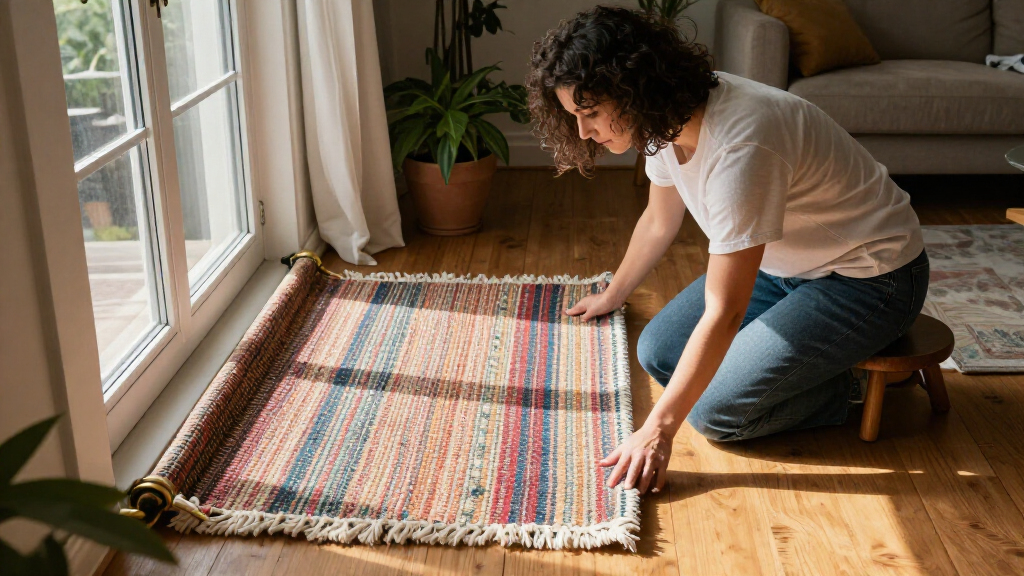
The project starts with a chindi rug, a type of rag rug made from strips of scrap fabric. Hunker’s account says the rugs are typically sewn together in narrow, twisted sections. Wood cut the binding strings to release the individual strips, then looped them around a curtain rod. The strips hang loosely, creating a flowing, multicolored look.
Aside from the rug, the basic materials are a curtain rod and sharp scissors. The amount of work depends on how much of the rug needs to be separated and how the strips are arranged. Hunker notes that the creator’s $5 purchase was one option; it also mentions an online chindi rug listed for $10, but prices and availability can change.
The treatment can be adjusted to the window and the desired style. Strips can be cut or joined to reach the preferred length, kept short for a valance, or varied in length for a layered effect. Hunker also describes alternatives to tying each strip directly to the rod: leave part of the rug intact as a header and attach it with curtain clips, or fasten the strips to a horizontal band so they move together.
A Low-Cost Decorative Alternative
The project gives renters and homeowners a way to reuse a relatively inexpensive textile as decor instead of buying a ready-made window treatment. Its appeal is mainly visual: chindi rugs bring together different colors, patterns and textures, which become more visible when their fabric is loosened from the rug’s woven or twisted form. Hunker says the result may suit bohemian or maximalist rooms.
That does not make the rug treatment a like-for-like substitute for standard curtains or blinds. The source describes a loosely hanging arrangement and does not report measurements, light-blocking performance, privacy, insulation or how well the fabric holds up over time. People considering it should treat it as a decorative DIY option unless they can confirm it meets their practical needs.
Products Worth Considering

Ring Battery Doorbell (1st Gen), 2-Pack, Satin Nickel

Ring Outdoor Cam 4K Plus Battery Security Camera, 3-Pack, White

Ring Floodlight Cam 2K Wired Security Camera, 3-Pack, Black
As an affiliate, we earn on qualifying purchases.
How the Rug Becomes a Curtain
Hunker’s report presents the idea as a reuse project: a rug designed as a floor covering is taken apart so its fabric can hang vertically. In Wood’s version, the strands are separated and tied around a rod. The method does not require sewing for the basic design, although sewing, tying or gluing the strips to a horizontal ribbon or fabric band is offered as a way to keep them together.
The design can be customized without adding much equipment. Hunker suggests tying the strips in knots or bows, bunching them with ribbon, loosely braiding strands, or adding beads. A copper pipe is one possible alternative to a conventional curtain rod. These are ideas described in the report, not tested performance recommendations; the source gives no installation specifications or information about load limits.
“a boho-chic curtain alternative”
— Hunker, describing the project
Coverage and Durability Remain Unknown
The report does not say how wide or tall Wood’s finished covering was, how many rugs were needed for her window, or whether the strands fully concealed the glass. It also provides no test or claim about privacy, sunlight control, insulation or durability. The method leaves fabric strips hanging loosely, so readers should not assume it offers the same function as blackout curtains or fitted blinds.
Other practical details are absent, including whether the fabric sheds, how it should be cleaned, how securely it stays on the rod, and whether the finished treatment is appropriate near heat sources or in homes with children or pets. The source does not give installation or safety guidance. Costs beyond the rug—such as a rod, clips or optional decorative materials—will vary, and the report does not provide a total project budget.
Check Fit Before Cutting Strips
Anyone trying the idea would need to measure the window and decide how much coverage is required before cutting the rug apart. Hunker’s instructions suggest setting strip lengths for a full-length treatment, a shorter valance or a mixed-length arrangement. Testing a small section first may help reveal the rug’s construction and how the fabric hangs, but that is a practical precaution, not a step attributed to Wood in the report.
The next considerations are whether the chosen rug can be separated cleanly and whether the finished arrangement meets the room’s needs for privacy and light. Readers should check the rug and rod attachment as they assemble the treatment; the original report gives no follow-up on Wood’s installation, longevity or use after the demonstration.
Key Questions
What is a chindi rug?
A chindi rug is a rag rug made from strips of scrap fabric. Hunker describes the rugs in this project as having strands bound or sewn into tight sections that can be cut apart.
How did the creator hang the rug fabric?
TikTok user Birdie Wood cut the binding strings to separate the fabric, then looped the strips around a curtain rod. Hunker also describes tying the strips onto a rod or fastening them to a horizontal band.
How much did the rugs cost?
Hunker reported that Wood found rugs for $5 each at Five Below. The report also cited an online example priced at $10, but that price may change and does not represent the total cost of every project.
Will this provide privacy or block sunlight?
The source does not establish how much privacy or light control the hanging strips provide. Because the fabric is described as loosely flowing, readers should not assume it performs like lined curtains or blinds.
Can the design be customized?
Yes. Hunker describes using different strip lengths, leaving part of the rug intact as a header, attaching fabric to a ribbon, or adding braids, ribbon or beads. These options change the appearance and arrangement; the report does not provide tested results for coverage or durability.
Source: hunker.com