
TL;DR

Get home appliances delivered free with Prime
- Fast, free delivery on millions of items
- Prime Video, Amazon Music and more included
- Member-only deals all year
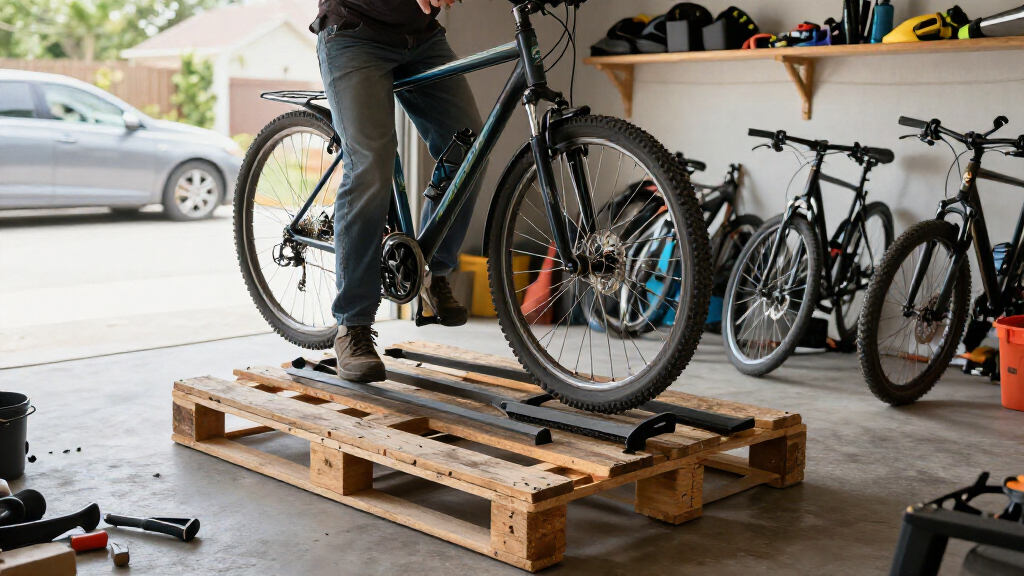
A Hunker report describes a DIY garage bike rack made by cutting a wood pallet lengthwise and repositioning its slats to hold bicycle tires. The ground-level design suits bikes with kickstands or training wheels; bikes without them need an added vertical support and bracing.
A Hunker report describes how to turn an old wood pallet into a garage bike rack by cutting it lengthwise and rearranging its slats to hold bicycle tires, much like other pallet upcycling projects. The ground-level design is intended for bikes with kickstands or training wheels; bicycles without those supports need an added upright section to keep them from tipping.
The basic rack starts with a pallet cut roughly in half lengthwise, close to one side of its center support. That leaves a narrower base for a single row of bicycles and may preserve the other half for reuse, as in this space-saving pallet furniture project. The report says the gaps between the pallet boards may be too wide for tires, so some slats can be removed and repositioned to create individual wheel slots.
The spacing should allow a tire to slide in without forcing it, while limiting room for the wheel to turn or lean. Hunker describes about a quarter-inch of wiggle room as a guide, not a universal measurement; the fit depends on the pallet and tires. Slats can be fastened again with sound existing nails or, if those are missing or damaged, wood screws. The report’s example accommodated five bikes, but capacity depends on the pallet’s size and the chosen spacing.
After assembly, the wood should be sanded to reduce splinter risk. Sealing or finishing is optional, according to the report. For bikes that lack kickstands or training wheels, an alternative tutorial from YouTube creator Your Own Adventure uses the other pallet half as an upright tire support. That version adds 2-by-4 lumber and brackets, with removed slats used as diagonal braces.
A Low-Cost Way to Clear Garage Space
A dedicated slot for each bicycle can make a crowded garage easier to use and give family members a clear place to return bikes. The pallet approach reuses material that may already be available, and its ground-level layout avoids the need to lift bicycles onto a wall-mounted hook. Those features may suit households that want accessible storage, though the report does not provide measured costs, durability tests or a comparison with commercial racks.
The main practical distinction is bike stability. A simple row of tire slots does not, by itself, hold every bicycle upright. Owners should match the design to their bikes and add the reinforced vertical section when needed rather than assuming that one configuration works for all. A rack also needs a suitable floor area and enough clearance for handlebars and other stored items.
Products Worth Considering

iRobot Roomba Max 715 Pet Robot Vacuum with AutoEmpty Dock

Dyson Cyclone V10 Origin Cordless Vacuum

Dyson V8 Cordless Vacuum
As an affiliate, we earn on qualifying purchases.
How the Pallet Design Is Built
The project is presented as a beginner-friendly reuse idea rather than a standardized product or tested building plan. In the account summarized by Hunker, YouTube user This Dad Goes to 11 used a pallet as a base, adjusted its top boards to separate wheels and created a parking position for each bike. The report says a wide pallet in that example held five bicycles.
For the upright variation, Hunker points to a separate tutorial by Your Own Adventure. Its method reuses the cut-off pallet section, reinforces it with 2-by-4 lumber, aligns the upper slats with the tire slots below and braces the assembly with metal shelf brackets, L-brackets or mending plates. The source describes these as construction options, not a tested load rating or guarantee of stability.
“The pallet gives each cycle a dedicated parking space.”
— Hunker, summarizing the tutorial by This Dad Goes to 11
Fit and Stability Depend on the Bikes
The source does not specify a tested weight limit, exact pallet dimensions, lumber grade or fastener schedule. It also does not report whether the designs were independently tested for stability or long-term wear. The suggested spacing and five-bike example should not be treated as specifications for every pallet or bicycle.
Before building, inspect the pallet for damage, loose boards and protruding nails, and check that its wood is suitable for indoor reuse. The report does not identify the pallet’s prior contents or treatment, so that history may be unknown. The exact support needed will depend on each bike’s design and the condition of the finished rack.
Check the Pallet Before Assembly
The next step for anyone considering the project is to measure the bikes and available floor area, then plan the tire slots around the actual wheels. Inspect and secure the pallet, cut and reposition the slats, and sand exposed surfaces before putting bicycles in the rack. Add an upright support and appropriate bracing for bikes that cannot remain stable on the base alone; check the completed rack for movement before relying on it.
Use eye protection and other suitable protective equipment when cutting or working with wood, and follow the tool manufacturer’s instructions. A circular saw is part of the reported method, but the source provides no detailed safety procedure. No further testing, product release or follow-up development is reported.
Key Questions
How does the pallet bike rack work?
A pallet is cut lengthwise and its slats are repositioned to make separate openings that hold bicycle tires. The report describes it as a floor-standing rack.
Will it hold bikes without kickstands?
Not necessarily in its basic form. Hunker says bikes without kickstands or training wheels need an added vertical tire support, reinforced with lumber and brackets.
How many bikes can one pallet hold?
The report describes one wide-pallet example holding five bikes. Capacity varies with pallet dimensions, tire widths and spacing; five is not a guaranteed limit or capacity for every build.
Do the pallet slots need a precise width?
The report suggests about a quarter-inch of wiggle room so a tire can enter without jamming while remaining supported. Measure the actual tires and test the fit, since the source gives no universal slot dimensions.
Does the wood need to be sealed?
Hunker says finishing or sealing is optional and depends on preference and expected wear. It recommends sanding the rack to reduce splinters, especially if the pallet is rough.
Source: hunker.com