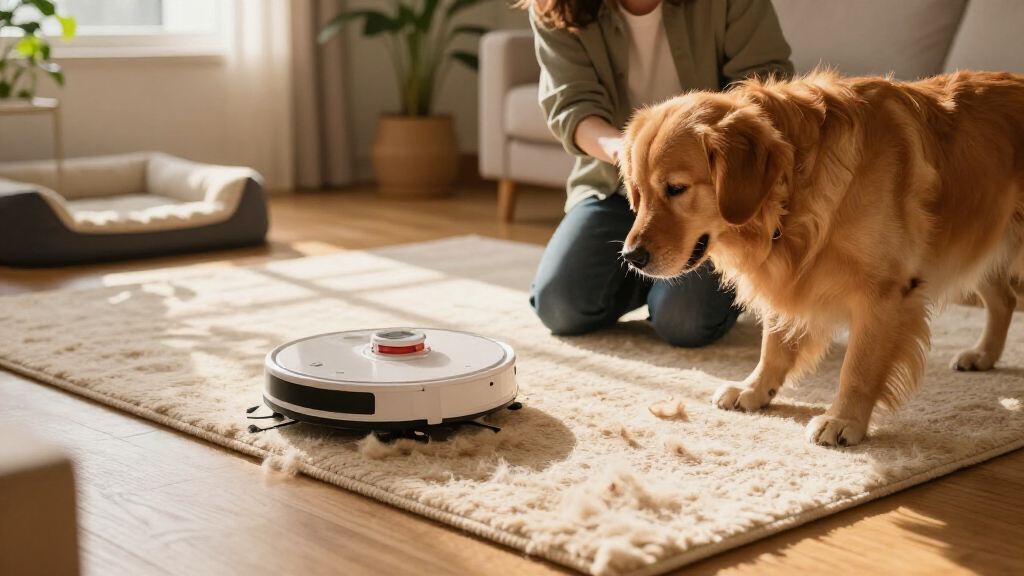

Shopping for robot vacuums for pet hair means balancing three things: suction strong enough to lift embedded fur from carpet, a brush system that resists tangling, and a dock that spares you from emptying a hair-filled bin every day. My top pick, the Roborock Qrevo 2 Pro, leads this lineup because its 20,000 Pa suction and dual anti-tangle brushes handle heavy shedders better than anything else here. The iRobot Roomba Max 715 Pet is the strongest pet-focused value thanks to its pet-specific engineering and auto-empty dock, while the Roborock Q7 M5+ is the smart mid-range choice if you want reliable mapping and self-emptying without paying premium prices. The main tradeoff in this category is between raw suction power (which costs more and often means bigger docks) and everyday usability (quieter runs, easier maintenance). Keep reading for the full ranked breakdown and which model fits your home, floors, and shedding situation.

Get home appliances delivered free — and shop member deals
- Fast, free delivery on millions of items
- Access to Prime Big Deal Days deals on October 6–7
- Prime Video, Amazon Music and more included
Complete the kit


Key Takeaways
- Suction specs alone didn’t predict pet hair performance — the Roborock Qrevo 2 Pro (20,000 Pa) won on suction, but the Roomba Max 715 Pet out-cleaned several higher-Pa models because its brush and bin design were built specifically around fur.
- Anti-tangle brush design mattered more than raw power for long-haired pets; dual rubber roller systems (Roomba Max 715, Qrevo models) needed far less manual scissors-and-cleaning time than bristle brushes on budget picks like the ROPVACNIC S1.
- Self-emptying docks shifted from luxury to near-necessity for multi-pet homes: models with 60-day capacity (Shark AV2501S, Shark AI Ultra) cut weekly maintenance dramatically compared with standard bins that fill with fur in one or two runs.
- The biggest price cliff in this lineup sits between LiDAR-mapped models and camera-gyro models — the Roborock Q7 L5 and Q7 M5+ delivered systematic, no-miss coverage for less, while Shark‘s Matrix Clean grid covered the same ground with a different approach.
- Vacuum-and-mop combos only help pet owners with hard floors; homes that are mostly carpet got better value from vacuum-only models like the Shark AI Ultra, which trade mop hardware for stronger fur pickup and bigger dust capacity.
| H6 Pro Self-Emptying Robot Vacuum and Mop with LiDAR Navigation |  | Best All-in-One for Multi-Floor Homes | Model: H6 Pro | Cleaning functions: Sweeping, vacuuming, and mopping | Suction power: 6000 Pa | VIEW LATEST PRICE | See Our Full Breakdown |
| Shark Matrix Plus Robot Vacuum and Mop Combo, AV2610WA |  | Best for Allergy Sufferers | Model: AV2610WA | Cleaning functions: Robot vacuum and sonic mop | Self-emptying capacity: Up to 60 days of dirt and debris | VIEW LATEST PRICE | See Our Full Breakdown |
| Roborock Q7 M5+ Robot Vacuum and Mop with Self-Emptying Dock |  | Best Value With Big Suction | Suction power: 10,000 Pa | Dust bag capacity: 2.7 L | Self-emptying interval: Up to 7–9 weeks | VIEW LATEST PRICE | See Our Full Breakdown |
| iRobot Roomba 105 Combo Robot Vacuum and Mop with AutoEmpty Dock |  | Best Beginner Combo | Navigation: ClearView LiDAR | Cleaning modes: Vacuum, mop, or vacuum and mop | AutoEmpty capacity: Up to 75 days of debris | VIEW LATEST PRICE | See Our Full Breakdown |
| iRobot Roomba Max 715 Pet Robot Vacuum with AutoEmpty Dock |  | Best for Serious Shedders | Suction power: 30,000 Pa | Brushes: Dual rubber anti-tangle brushes and anti-tangle edge-sweeping brush | Self-emptying: Up to 90 days | VIEW LATEST PRICE | See Our Full Breakdown |
| iRobot Roomba 115 Combo Robot Vacuum and Mop with AutoEmpty Dock |  | Best Allergen Control | Suction power: 15,000 Pa | Coverage per charge: Up to 900 sq. ft. | Dust bag capacity: 2.5 L, allergen-sealed | VIEW LATEST PRICE | See Our Full Breakdown |
| Roborock Robot Vacuum and Mop with LiDAR and 10,000 Pa Suction |  | Best Midrange Workhorse | Suction power: 10,000 Pa | Battery life: 150 minutes | Dust bag capacity: 2.7 L | VIEW LATEST PRICE | See Our Full Breakdown |
| ROPVACNIC Robot S1 Vacuum and Mop Combo, 5200 Pa |  | Best Budget Pick | Suction power: 5200 Pa | Functions: Vacuuming and mopping | Water adjustment: 4 levels | VIEW LATEST PRICE | See Our Full Breakdown |
| iRobot Roomba Plus 415X Robot Vacuum and Mop Combo |  | Best Full-Service Dock | Suction: 2.3x more than Roomba 600 series | Dock debris emptying: Up to 90 days | Mop pad drying temperature: 113°F | VIEW LATEST PRICE | See Our Full Breakdown |
| Roborock Qrevo 2 Pro Robot Vacuum and Mop, 20,000 Pa Suction |  | Best Premium Pick | Suction power: 20,000 Pa | Noise level: 54 dB | Mop lift: Up to 15 mm | VIEW LATEST PRICE | See Our Full Breakdown |
| Roborock Qrevo S Pro Robot Vacuum and Mop |  | Best Premium Self-Cleaning Dock | Suction power: 18,500 Pa | Dust bag capacity: 2.7 L | Dust bag runtime: 7–9 weeks | VIEW LATEST PRICE | See Our Full Breakdown |
| Shark AV2501S AI Ultra Robot Vacuum with Matrix Clean and Self-Empty Base |  | Best for Allergy Sufferers | Navigation: Matrix Clean with 360° LiDAR home mapping | Base capacity: Up to 30 days of debris | Filtration: HEPA; 99.97% at 0.3 microns | VIEW LATEST PRICE | See Our Full Breakdown |
| Shark AI Ultra Robot Vacuum with 60-Day Self-Emptying Base (AV2511AE) |  | Best Value Self-Empty Pick | Model: AV2511AE | Self-empty base capacity: Up to 60 days | Navigation: 360° LiDAR | VIEW LATEST PRICE | See Our Full Breakdown |
| Roborock Q7 L5 Robot Vacuum and Mop Combo |  | Best for Multi-Floor Homes | Suction power: 8,000 Pa | Navigation: LiDAR | Water tank capacity: 270 ml | VIEW LATEST PRICE | See Our Full Breakdown |
| D13S MAX Robot Vacuum and Mop with Self-Emptying Station |  | Best Budget Hybrid with Self-Emptying | Suction power: 11,500 Pa | Functions: Vacuuming, sweeping, mopping | Water tank capacity: 230 ml | VIEW LATEST PRICE | See Our Full Breakdown |
| robot vacuums for pet hair | Navigation | Suction power |
|---|---|---|
| H6 Pro Self-Emptying Robot Vac | 360° LiDAR with multi-level mapping | 6000 Pa |
| Shark Matrix Plus Robot Vacuum | 360° LiDAR mapping | — |
| Roborock Q7 M5+ Robot Vacuum a | PreciSense LiDAR | 10,000 Pa |
| iRobot Roomba 105 Combo Robot | ClearView LiDAR | — |
| iRobot Roomba Max 715 Pet Robo | ClearView Pro LiDAR with 3D mapping | 30,000 Pa |
| iRobot Roomba 115 Combo Robot | ClearView LiDAR | 15,000 Pa |
| Roborock Robot Vacuum and Mop | PreciSense LiDAR | 10,000 Pa |
| ROPVACNIC Robot S1 Vacuum and | — | 5200 Pa |
| iRobot Roomba Plus 415X Robot | — | — |
| Roborock Qrevo 2 Pro Robot Vac | — | 20,000 Pa |
| Roborock Qrevo S Pro Robot Vac | — | 18,500 Pa |
| Shark AV2501S AI Ultra Robot V | Matrix Clean with 360° LiDAR home mapping | — |
| Shark AI Ultra Robot Vacuum wi | 360° LiDAR | — |
| Roborock Q7 L5 Robot Vacuum an | LiDAR | 8,000 Pa |
| D13S MAX Robot Vacuum and Mop | LiDAR | 11,500 Pa |
More Details on Our Top Picks
H6 Pro Self-Emptying Robot Vacuum and Mop with LiDAR Navigation
The H6 Pro stands out for buyers juggling pets across more than one floor, because its 360° LiDAR multi-level mapping lets it move between floor plans without relearning the layout — something single-map models like the Roborock Q7 M5+ handle less gracefully. The three-in-one sweep-vacuum-mop routine means one pass handles kibble crumbs and tracked-in muddy paw prints, and the 3 L self-emptying dock cuts maintenance to a rare chore. Compared with the Roomba 105 Combo, the 6000 Pa suction is modest, so deeply embedded fur in high-pile carpet is not this machine’s strength. The tradeoff for the do-everything design: the 90-day hands-free claim shrinks fast in shedding season, and there is no mop-pad washing or drying, so the pad needs manual rinsing to avoid odor.
Pros:- Sweeps, vacuums, and mops in a single pass
- Multi-level LiDAR mapping supports separate floor plans
- 3 L self-emptying dock minimizes hands-on maintenance
- Automatic recharge and resume finishes long cleaning jobs
Cons:- The 90-day dock interval depends heavily on shedding volume
- No mop-pad washing or drying, so pads need manual care
Best for: Pet owners in two-story homes who want vacuuming and mopping handled by one scheduled robot
Not ideal for: Households with heavy-shedding dogs on thick carpets — the midrange suction and small 250 ml dustbin rely heavily on the dock
- Model:H6 Pro
- Cleaning functions:Sweeping, vacuuming, and mopping
- Suction power:6000 Pa
- Navigation:360° LiDAR with multi-level mapping
- Dust collection station capacity:3 L
- Water tank capacity:310 ml
- Runtime:Up to 150 minutes
- Controls:App, Alexa, and Google Assistant
- Warranty:2 years
Our verdict“A sensible pick for multi-floor pet households that want one robot for everything, as long as carpets are low-pile.”
Shark Matrix Plus Robot Vacuum and Mop Combo, AV2610WA
What separates the Shark Matrix Plus AV2610WA from the rest of this lineup is the True HEPA filtration in its self-emptying base, capturing 99.97% of dust and allergens down to 0.3 microns — a genuine advantage when pet dander is the problem, not just visible hair. Where the H6 Pro empties into a bagless system you may prefer to avoid, this Shark’s sealed HEPA base keeps fine particles contained during disposal. The self-cleaning brushroll targets the most annoying pet-hair failure mode: wrap around the brush. Its 100-scrubs-per-minute sonic mopping is light-duty compared with the Roborock options here — fine for paw prints, not sanitized floors — and mopping skips carpets entirely. The bagless base also means you empty debris yourself rather than tossing a sealed bag, which allergy sufferers should weigh carefully.
Pros:- True HEPA filtration captures 99.97% of allergens down to 0.3 microns
- Self-cleaning brushroll resists hair wrap
- LiDAR mapping delivers methodical grid coverage
- Base holds up to 60 days of debris
Cons:- Mopping is hard-floor only and light-duty
- Bagless base exposes you to dust during emptying despite HEPA capture
Best for: Pet owners whose main concern is dander and allergens on hard floors and low-pile rugs
Not ideal for: Homes with mostly carpet — the sonic mop is hard-floor only, so the combo appeal disappears
- Model:AV2610WA
- Cleaning functions:Robot vacuum and sonic mop
- Self-emptying capacity:Up to 60 days of dirt and debris
- Navigation:360° LiDAR mapping
- Filtration:True HEPA; 99.97% at 0.3 microns
- Mopping rate:100 scrubs per minute
- Included accessories:XL HEPA base, 2 reusable mop pads, filter, side brush, 12 oz cleaning solution
- Warranty:1-year limited
Our verdict“The pick for allergy-focused buyers, provided your home is mostly hard flooring.”
Roborock Q7 M5+ Robot Vacuum and Mop with Self-Emptying Dock
The Roborock Q7 M5+ makes this list because it pairs 10,000 Pa suction with a 2.7 L sealed dust bag that stretches 7–9 weeks between changes — a combination that punches well above its position for a pet-hair household. That sealed bag matters: unlike the Shark Matrix Plus‘s bagless base, disposal here is a clean swap with no dust cloud, which matters when the debris is mostly fur and dander. The anti-tangle brush design handles long pet hair without the wrap problems that plague basic brushrolls, and three water-flow settings give you real control over mopping dampness — the Roomba 105 Combo offers less flexibility there. The main compromises are connectivity and finesse: the app works on 2.4 GHz Wi-Fi only, which trips up homes running mesh networks, and there’s no carpet-detection mop avoidance, so you must set no-go zones yourself.
Pros:- 10,000 Pa suction lifts embedded pet hair from carpets
- Sealed 2.7 L bag allows 7–9 weeks between emptying
- Anti-tangle brush design resists hair wrap
- LiDAR mapping with scheduling and no-go zones
Cons:- App supports only 2.4 GHz Wi-Fi
- Water flow must be adjusted manually to match the job
Best for: Budget-conscious pet owners who want high suction and a sealed self-emptying system without paying for premium extras
Not ideal for: Tech-forward homes on 5 GHz-only mesh networks, or anyone who wants the robot to dodge carpets while mopping automatically
- Suction power:10,000 Pa
- Dust bag capacity:2.7 L
- Self-emptying interval:Up to 7–9 weeks
- Navigation:PreciSense LiDAR
- Water-flow settings:3
- Brush design:Anti-tangle
- Wi-Fi support:2.4 GHz only
Our verdict“The strongest suction-per-dollar pick here for shedding homes, if your router plays along.”
iRobot Roomba 105 Combo Robot Vacuum and Mop with AutoEmpty Dock
The Roomba 105 Combo earns its spot as the friendliest entry point into combined vacuum-and-mop cleaning. Its ClearView LiDAR mapping and three straightforward modes — vacuum only, mop only, or both — mean there’s little to configure before it just works, a simpler on-ramp than the Roborock’s water-flow tuning or the H6 Pro‘s multi-floor setup. The standout pet-friendly trick is carpet detection: it avoids rugs while mopping, so you never come home to a damp carpet, something the Q7 M5+ leaves to your no-go zones. Its 75-day AutoEmpty capacity sits between the Roborock’s 7–9 weeks and the Roomba Max 715‘s 90 days. The tradeoffs are real, though: suction is unlisted and clearly not the headline feature, and you’re nudged toward iRobot’s own cleaning solutions, which adds a running cost other picks avoid.
Pros:- Vacuum, mop, and combo modes in one robot
- Carpet detection keeps rugs dry during mopping
- AutoEmpty Dock holds up to 75 days of debris
- ClearView LiDAR mapping provides precise coverage
Cons:- Only compatible cleaning solutions are recommended, adding ongoing cost
- Modest suction compared with 10,000 Pa-plus rivals in this lineup
Best for: First-time robot vacuum buyers who want a simple set-and-forget combo that won’t soak their rugs
Not ideal for: Heavy-shedding households needing serious carpet extraction — dedicated vacuums like the Max 715 do that job far better
- Navigation:ClearView LiDAR
- Cleaning modes:Vacuum, mop, or vacuum and mop
- AutoEmpty capacity:Up to 75 days of debris
- Carpet detection:Avoids carpets while mopping
- Wi-Fi:2.4 GHz
- Included accessories:AutoEmpty Dock, extra mop pad
Our verdict“A low-hassle starter combo that trades raw power for ease and dry carpets.”
iRobot Roomba Max 715 Pet Robot Vacuum with AutoEmpty Dock
When pet hair is the entire problem, the Roomba Max 715 is the specialist. Its 30,000 Pa suction with Carpet Boost dwarfs the Q7 M5+‘s 10,000 Pa and the H6 Pro‘s 6000 Pa, and the dual rubber anti-tangle brushes with an anti-tangle edge brush are built specifically to keep long dog hair off the brushroll rather than wound around it. Add PrecisionVision AI obstacle avoidance — so it steers around food bowls and stray toys — plus Advanced Dirt Detect that revisits fur pileups, and it behaves like a pet owner would. The obvious gap: no mopping at all, which is why the combo models exist. And while the dock holds up to 90 days of debris, the AutoEmpty bags need replacing roughly four times a year, a recurring cost bag-averse buyers should factor in.
Pros:- 30,000 Pa suction with Carpet Boost for rugs and carpets
- Dual rubber anti-tangle brushes resist hair wrap
- AI obstacle avoidance dodges pet bowls and clutter
- Dirt Detect targets fur accumulation zones
Cons:- No mopping function at all
- AutoEmpty bags require replacement roughly four times a year
Best for: Owners of long-haired, heavy-shedding dogs who care more about carpet extraction than mopping
Not ideal for: Anyone wanting mopping in the same robot — this is a vacuum-only specialist
- Suction power:30,000 Pa
- Brushes:Dual rubber anti-tangle brushes and anti-tangle edge-sweeping brush
- Self-emptying:Up to 90 days
- Navigation:ClearView Pro LiDAR with 3D mapping
- Obstacle avoidance:PrecisionVision AI
- Dirt detection:Advanced Dirt Detect
- Voice control:Alexa, Siri, and Google Assistant-enabled devices
Our verdict“The most powerful pure vacuum here for shedding-heavy homes — just don’t expect it to mop.”
iRobot Roomba 115 Combo Robot Vacuum and Mop with AutoEmpty Dock
This option stands out for its sealed allergen-trapping dust bag, which captures 99% of pollen and mold — a meaningful advantage for pet households where dander is the real problem, not just visible hair. Compared with the ROPVACNIC Robot S1, the Roomba 115 Combo brings LiDAR mapping and a genuine self-emptying dock rather than basic obstacle detection, so multi-room cleaning runs on a plan instead of luck. The No Mop Zones feature protects rugs the way the Roborock Qrevo 2 Pro‘s mop lift does, though at a lower suction rating of 15,000 Pa. Tradeoffs are real: coverage tops out at 900 sq. ft. per charge, and the setup demands 2.4 GHz Wi-Fi plus periodic filter and brush replacements.
Pros:- Vacuums and mops in a single pass across mapped rooms
- Sealed dust bag traps 99% of pollen and mold for up to three months
- ClearView LiDAR navigation with obstacle avoidance
- No Mop Zones keep rugs dry while mopping hard floors
Cons:- Coverage is capped at 900 sq. ft. per charge
- Filters and brushes need replacement every 3–6 months
- Requires 2.4 GHz Wi-Fi for setup and smart features
Best for: Pet owners with allergies who want three months of hands-free, sealed debris disposal
Not ideal for: Owners of very large homes, since a single charge covers only up to 900 sq. ft.
- Suction power:15,000 Pa
- Coverage per charge:Up to 900 sq. ft.
- Dust bag capacity:2.5 L, allergen-sealed
- Navigation:ClearView LiDAR
- Mop pad:Washable microfiber
- Cleaning modes:Vacuum and mop; spot clean; SmartScrub
- Dust bag lifespan:Up to 3 months
Our verdict“A strong pick for allergy-sensitive pet households that value sealed debris handling over maximum suction or runtime.”
Roborock Robot Vacuum and Mop with LiDAR and 10,000 Pa Suction
This model makes the most sense for buyers who want dependable everyday pet-hair cleanup without paying premium prices. Its 10,000 Pa suction trails the Roborock Qrevo 2 Pro‘s 20,000 Pa, but the anti-tangle brush design means long cat hair won’t wrap around the roller the way it can on cheaper machines like the ROPVACNIC Robot S1‘s dual side brushes. The 2.7 L self-emptying bag lasts a realistic 7–9 weeks, and the 150-minute runtime comfortably beats the Roomba 115 Combo‘s 900 sq. ft. per-charge limit, making this the better fit for larger floor plans. Tradeoffs: water flow has only three settings, and it lacks a mop-washing dock, so pad maintenance stays manual.
Pros:- 150-minute runtime suits larger multi-room homes
- Anti-tangle brush resists pet hair wrapping
- 2.7 L self-emptying dust bag lasts up to 7–9 weeks
- PreciSense LiDAR planning with app and voice control
Cons:- Suction of 10,000 Pa lags higher-end pet-focused rivals
- Mop pad must be washed by hand — no automated pad cleaning
- 2.4 GHz-only Wi-Fi connectivity
Best for: Pet owners in larger homes who prioritize runtime and low-maintenance dust disposal over mop automation
Not ideal for: Buyers who want the dock to wash and dry mop pads — that convenience lives with the Qrevo 2 Pro or Roomba Plus 415X
- Suction power:10,000 Pa
- Battery life:150 minutes
- Dust bag capacity:2.7 L
- Navigation:PreciSense LiDAR
- Cleaning path width:12.8 inches
- Water flow settings:3
- Noise level:65 dB
Our verdict“A balanced, longer-running alternative for bigger homes where mop self-cleaning is a nice-to-have, not a must.”
ROPVACNIC Robot S1 Vacuum and Mop Combo, 5200 Pa
For a first robot vacuum or a smaller apartment shared with a shedding dog, this pick covers the basics at a lower commitment than the Roborock 10,000 Pa model. The standout design choice is the roller-brush-free system with dual rotating side brushes — there is no brush roller for hair to tangle around, which is a genuinely practical answer to the messiest part of pet ownership. Four water levels and three suction levels give more fine-tuning than the Roomba 115 Combo‘s three solution levels. The tradeoffs are obvious next to pricier rivals: 5200 Pa suction is modest, there is no self-emptying dock, and no runtime figure is listed, so large homes are off the table. Low-pile carpet support only reinforces that this is a hard-floor machine.
Pros:- Roller-brush-free design eliminates tangled pet hair
- Four water-flow levels offer flexible mopping control
- App and voice control via Alexa and Google Assistant
- Automatic obstacle detection and self-recharging
Cons:- 5200 Pa suction is the weakest in this lineup
- No self-emptying dock — you empty the bin yourself
- Limited to low-pile carpets; no listed runtime
Best for: Budget-conscious pet owners in apartments or small homes with mostly hard floors
Not ideal for: Large homes or plush-carpet households needing strong suction and a self-emptying dock
- Suction power:5200 Pa
- Functions:Vacuuming and mopping
- Water adjustment:4 levels
- Suction adjustment:3 levels
- Pet hair design:Roller-brush-free, dual rotating side brushes
- Surfaces:Wood, hard floors, low-pile carpet
- Voice assistants:Alexa, Google Assistant
Our verdict“An entry-level choice that solves the tangle problem cheaply, as long as your home is small and mostly hard-floored.”
iRobot Roomba Plus 415X Robot Vacuum and Mop Combo
Where the Roborock 10,000 Pa model stops at self-emptying, this Roomba goes all the way: its AutoWash Dock washes and heat-dries the mop pads, empties debris for up to 90 days, and refills water. That combination matters most for pet owners tired of touching dirty mop pads. The tangle-free brushes engineered for pet hair and a 10 mm mop lift over rugs mirror the pet-first thinking of the Roborock Qrevo 2 Pro, though iRobot expresses suction as “2.3x more than the Roomba 600 series” rather than a Pa figure, which makes direct comparison awkward. The dock also demands real upkeep — water refills and periodic maintenance are on you, so hands-free here means fewer chores, not zero.
Pros:- Dock washes and heat-dries mop pads automatically
- Empties debris for up to 90 days and refills robot water
- Tangle-free brushes built specifically for pet hair
- Lifts mop pads 10 mm over rugs with obstacle recognition
Cons:- Dock requires regular water refills and cleaning
- Suction is only described relative to the older Roomba 600 series
- Full dock automation adds bulk and upkeep compared with simple self-empty models
Best for: Pet owners who want the dock to handle mop washing, drying, dust emptying, and water refilling in one station
Not ideal for: Buyers who want zero dock maintenance or a clear Pa suction rating for comparison shopping
- Suction:2.3x more than Roomba 600 series
- Dock debris emptying:Up to 90 days
- Mop pad drying temperature:113°F
- Mop lift over rugs:10 mm
- Mapping:LiDAR
- Controls:App and voice control
Our verdict“The closest thing to a self-maintaining pet-cleaning system here, if you accept dock upkeep and vaguer suction specs.”
Roborock Qrevo 2 Pro Robot Vacuum and Mop, 20,000 Pa Suction
This is the most complete package in the batch, and the ranking logic is simple: nothing else here combines 20,000 Pa suction with a dock that empties dust, refills water, washes the mop at 149°F, and heat-dries it at 113°F. Compared with the Roomba Plus 415X, the Qrevo 2 Pro doubles down on edge cleaning — getting within 1.85 mm of walls, exactly where pet hair collects — and lifts its mop a taller 15 mm over carpet. At 54 dB, it also runs quieter than the Roborock 10,000 Pa model‘s 65 dB. The honest tradeoff is cost and complexity: this level of automation is overkill for a small apartment, and it still needs 2.4 GHz Wi-Fi like every rival here.
Pros:- 20,000 Pa suction with automatic carpet boost
- Anti-tangle brush system designed for heavy pet hair
- Dock handles dust emptying, water refilling, mop washing, and drying
- Cleans within 1.85 mm of walls and lifts mop 15 mm over carpet
Cons:- Premium feature set commands a premium price
- 2.4 GHz-only Wi-Fi
- Full dock automation means more components to maintain over time
Best for: Pet owners with mixed hard floors and carpet who want maximum suction and near-total dock automation
Not ideal for: Small-apartment dwellers or tight budgets, where the ROPVACNIC S1 handles the job for far less
- Suction power:20,000 Pa
- Noise level:54 dB
- Mop lift:Up to 15 mm
- Edge cleaning distance:As close as 1.85 mm along walls
- Mop self-cleaning temperature:149°F
- Mop drying temperature:113°F
- Dock functions:Dust emptying, water refilling, mop washing, mop drying
Our verdict“The top of this lineup for serious pet-hair volume — worth it only if near-total automation is the goal.”
Roborock Qrevo S Pro Robot Vacuum and Mop
This option stands out for doing nearly everything a pet-hair household could ask: 18,500 Pa suction, anti-tangle brushes, and a dock that empties dust, then washes mops at 167°F and dries them. That hot-water wash matters for pet owners because it breaks down grime a cold rinse leaves behind. Compared with the Roborock Q7 L5, the Qrevo S Pro trades affordability for a fully automated dock — the Q7 makes you rinse pads by hand. The tradeoff is real: periodic dock maintenance is part of the deal, and 2.4 GHz-only Wi-Fi may frustrate modern mesh-network homes. At 3.8 inches tall, it also fits under more furniture than most full-size rivals.
Pros:- High 18,500 Pa suction pulls embedded pet hair from carpet
- Dock empties dust, washes mops in hot water, and dries them
- Anti-tangle brush design reduces hair wrap
- 10 mm mop lift and boosted suction protect carpets
Cons:- 2.4 GHz-only Wi-Fi limits router compatibility
- Dock requires periodic maintenance of its washing and emptying systems
Best for: Multi-pet households with mostly hard floors who want mop washing and drying handled automatically
Not ideal for: Buyers on tight budgets or homes with 5 GHz-only networks — the Wi-Fi limitation and premium feature set may not justify the cost
- Suction power:18,500 Pa
- Dust bag capacity:2.7 L
- Dust bag runtime:7–9 weeks
- Mop washing temperature:167°F
- Mop lift:10 mm
- Robot height:3.8 in
- Noise level:55 dB
Our verdict“If pet messes extend to muddy paws and you want the dock to handle mop cleanup, this is the most hands-off option in the lineup.”
Shark AV2501S AI Ultra Robot Vacuum with Matrix Clean and Self-Empty Base
The AV2501S earns its place through HEPA filtration that captures 99.97% of allergens down to 0.3 microns — a genuine differentiator in a pet roundup, since dander is often the bigger problem than the hair itself. Shark’s Matrix Clean grid navigation passes over floors multiple times, which helps with hair that a single sweep scatters. Its 30-day bagless base holds less than the Shark AV2511AE’s 60-day base, but the sealed filtration system here matters more for allergy-prone homes. Runtime tops out at 120 minutes, so sprawling single-story houses may see it return to charge mid-job, though Recharge and Resume lets it finish the task.
Pros:- HEPA self-empty base traps allergens at 0.3 microns
- Matrix Clean grid pattern catches hair a single pass misses
- LiDAR mapping delivers systematic, non-random coverage
- Recharge and Resume completes long cleaning sessions
Cons:- 120-minute runtime caps coverage per charge in larger homes
- No mopping function at this price point
Best for: Pet owners whose main concern is dander and allergens rather than mopping
Not ideal for: Homes wanting mopping — this is a vacuum-only model, unlike the Q7 L5 or D13S MAX
- Navigation:Matrix Clean with 360° LiDAR home mapping
- Base capacity:Up to 30 days of debris
- Filtration:HEPA; 99.97% at 0.3 microns
- Runtime:Up to 120 minutes
- Voice control:Amazon Alexa and Google Assistant
- Included:Robot, HEPA self-empty base, 2 side brushes
Our verdict“The strongest pick here for pet allergies, provided you don’t need a mop.”
Shark AI Ultra Robot Vacuum with 60-Day Self-Emptying Base (AV2511AE)
The AV2511AE makes the list because it stretches maintenance intervals further than its sibling: a bagless base holding up to 60 days of debris, double the AV2501S’s capacity. For shedding-heavy homes, that means fewer trips to the trash can with a fistful of fur. The self-cleaning brushroll is the other pet-specific draw, actively pulling hair off itself rather than wrapping it. The compromise is runtime — up to 90 minutes, the shortest in this batch, so large homes will lean hard on Recharge-and-Resume. It also skips the AV2501S’s HEPA base filtration, and conflicting mopping claims mean buyers should treat this as a vacuum-only purchase.
Pros:- 60-day bagless base is the longest interval among Shark picks here
- Self-cleaning brushroll resists hair wrap
- LiDAR grid navigation cleans methodically on carpet and hard floors
- App, Alexa, and Google Assistant control included
Cons:- 90-minute runtime is the shortest of this batch
- Mopping claims are unclear and no mop appears in the box
Best for: Budget-conscious shedding-house households who want maximum time between emptying the base
Not ideal for: Allergy-sensitive buyers — the AV2501S’s HEPA base is the better choice — and anyone needing long single-charge coverage
- Model:AV2511AE
- Self-empty base capacity:Up to 60 days
- Navigation:360° LiDAR
- Brushroll:Self-cleaning
- Runtime:Up to 90 minutes
- Controls:SharkClean app, Alexa, Google Assistant
Our verdict“The practical middle ground if your priority is rarely thinking about pet hair — just don’t expect it to mop.”
Roborock Q7 L5 Robot Vacuum and Mop Combo
The Q7 L5’s strength is mapping intelligence at a midrange price: LiDAR navigation with multi-floor maps, no-go zones, and scheduling — features pet owners use to keep the robot out of the cat’s food station or off a favorite rug. Its 8,000 Pa suction with automatic carpet boost is less than the D13S MAX’s 11,500 Pa, but adequate for daily hair pickup, and its 150-minute runtime outlasts both Shark models here. The main compromise is the combo tank: because the 270 ml water tank and dustbin are integrated, mopping reduces dustbin capacity — a real annoyance in heavy-shedding homes. Unlike the Qrevo S Pro, the mop pads are a simpler design with no dock washing.
Pros:- 150-minute battery outlasts every Shark in this roundup
- Multi-floor maps and no-go zones keep pets’ areas untouched
- Simultaneous vacuum and mop with carpet boost
- Anti-tangle brushes reduce hair wrap
Cons:- Integrated dustbin/water tank sacrifices capacity when mopping
- 2.4 GHz-only Wi-Fi support
Best for: Owners of two-story homes who need multi-floor mapping and long runtime without paying for a premium dock
Not ideal for: Heavy shedders who mop often — the shared tank design cuts dustbin capacity when mopping
- Suction power:8,000 Pa
- Navigation:LiDAR
- Water tank capacity:270 ml
- Battery life:150 minutes
- Filter:Washable
- Noise level:60 dB
- Surfaces:Carpet, laminate, tile, vinyl, wood, marble
Our verdict“The smartest pick for split-level pet homes that value mapping and endurance over raw suction or a self-washing dock.”
D13S MAX Robot Vacuum and Mop with Self-Emptying Station
The D13S MAX undercuts the established brands while combining three things that usually cost more: 11,500 Pa suction, mopping, and a self-emptying station rated for 90 days. That maintenance interval beats even the Roborock Qrevo S Pro’s 7–9 week bag — though real-world capacity will shrink quickly in multi-pet homes. Its 160-minute runtime is the longest in this batch, edging out the Q7 L5 by ten minutes. The compromises show in the details: a 240 ml dustbin and 230 ml water tank are small, so the robot depends heavily on the station, and buyers trade brand maturity and refinement for the price. Compared with the AV2511AE, you get mopping and longer runtime, but less proven reliability.
Pros:- Three functions — vacuum, sweep, mop — in one budget package
- 90-day rated self-empty station minimizes hands-on upkeep
- Longest runtime in this batch at 160 minutes
- Automatic carpet suction boost and multi-floor LiDAR maps
Cons:- Small 240 ml dustbin and 230 ml tank limit standalone capacity
- Newer brand with a shorter reliability record than Roborock or Shark
Best for: First-time robot vacuum buyers who want vacuum, mop, and self-emptying together without a premium outlay
Not ideal for: Buyers who prioritize brand track record and established app support — the lesser-known name carries more long-term uncertainty
- Suction power:11,500 Pa
- Functions:Vacuuming, sweeping, mopping
- Water tank capacity:230 ml
- Dustbin capacity:240 ml
- Navigation:LiDAR
- Runtime:160 minutes
- Self-empty dust bag:90-day capacity; 5 bags included
Our verdict“A feature-dense entry point for buyers willing to trade brand pedigree for mopping plus self-emptying at a lower cost.”

How We Picked
I judged every model here through one lens: how well it handles pet hair specifically, not general cleaning scores. That meant weighting four factors most heavily — suction consistency on carpet pile, brush and edge-sweeping resistance to hair tangles, bin and dock capacity relative to daily fur volume, and navigation that actually covers shedding hotspots (under couches, along baseboards, around food bowls). LiDAR-based systems like the Roborock models earned ranking credit for systematic coverage and no-go zones, which matter when you’re keeping a robot away from water bowls or litter areas.
The ranking order also reflects total ownership value, not just spec sheets. A model with a slightly lower Pa rating but a genuine anti-tangle roller and a reliable self-empty dock placed higher than a high-suction unit that requires weekly brush surgery. I also factored in floor-type fit: vacuum-mop hybrids ranked best for mixed hard-floor homes, while vacuum-only units like the Shark AI Ultra ranked higher for carpeted houses where mop hardware is dead weight. Finally, I compared each model against its closest neighbor in the lineup — same brand, similar price — so the order reflects real differentiation rather than marketing tiers.
Factors to Consider When Choosing Robot Vacuums For Pet Hair
Before choosing a specific model, it helps to understand what actually separates a good pet-hair robot from a mediocre one. These are the factors that drove my rankings — and the mistakes I see buyers make most often.Suction Power vs. Brush Design: Which Actually Removes Fur?
Manufacturers love advertising Pa numbers, and they do matter — but only up to a point. Suction above roughly 5,000 Pa is generally enough to pull surface fur from medium-pile carpet; beyond 10,000 Pa, you’re mostly paying for performance on dense rugs and embedded dander. What matters more for pet owners is the brush system. Bristle brushes trap long pet hair and force you to cut tangles out weekly, while dual rubber rollers and anti-tangle edge brushes shed fur into the bin instead. The most common buyer mistake is choosing the highest Pa number on the page and ending up with a robot that requires more maintenance than the pet does. If you have a long-haired dog or a shedding cat, prioritize brush design first, suction second.
Self-Emptying Docks: When They’re Worth the Money
A standard robot bin holds maybe one or two runs’ worth of fur in a multi-pet home — which means you’re handling a clump of hair every single day, defeating much of the purpose. A self-emptying dock solves this, but capacities vary widely: some hold 30 days of debris, others 60 or more, and that difference compounds fast with heavy shedders. The tradeoff is dock size, bag cost over time, and noise during the empty cycle — some docks are loud enough to startle pets. My advice: single short-haired pet, a dock is a nice-to-have; two or more pets or any long-haired breed, and it becomes the single highest-value upgrade you can buy. Also check whether the dock uses disposable bags or a washable canister, since that affects both cost and convenience.
Navigation Type: LiDAR, Camera, or Gyro
Navigation determines whether your robot cleans systematically or bounces around semi-randomly — and with pet hair, coverage consistency is everything, because fur accumulates in the same corners every day. LiDAR models (the Roborock lineup here) map in the dark, follow methodical lanes, and let you draw keep-out zones around pet bowls and litter boxes. Camera-based systems like Shark’s add obstacle avoidance, which is genuinely useful if your pet leaves toys — or accidents — on the floor. Gyro-only budget robots will eventually cover a room but miss spots and can’t reliably honor no-go zones. Dark rooms, long hallways, and furniture-dense layouts all favor LiDAR; open floor plans with pet clutter favor good obstacle avoidance.
Vacuum-Mop Combo or Vacuum-Only?
Combos dominate this category, but they’re not automatically the right call for pet owners. Mopping adds value for paw prints and dander on hard floors, and some higher-end models lift or retract the mop when crossing carpet, which is the feature that makes hybrids genuinely practical. Cheaper combos without mop-lifting force you to physically remove the pad before every carpet run — a friction point that makes owners stop mopping entirely within a month. If your home is mostly carpet, a vacuum-only model like the Shark AI Ultra typically gives you stronger fur pickup and a larger dust capacity for the same money. Match the tool to your actual floor mix, not to the feature checklist.
Maintenance Reality: Hair Wraps, Filters, and Sensors
The hidden cost of pet-hair robots is maintenance time. Every model here needs its filter tapped clean or replaced periodically, its sensors wiped, and — on non-anti-tangle models — its brush cleared of wrapped hair. Models with washable bins and removable rollers cut this chore to minutes; models with glued-in components turn it into a monthly project. Check replacement part availability before buying, because HEPA-style filters on pet models clog faster than on child-free homes and need replacing more often. A robot that scores slightly lower on suction but cleans itself in five minutes a week will get used; a high-maintenance one ends up parked in a corner, and that’s the real failure mode to avoid.
Where to Spend More — and Where Not To
The honest tiering in this category: entry-level models around the ROPVACNIC S1 handle light shedding on hard floors acceptably; mid-tier LiDAR models like the Roborock Q7 series add the mapping and dock features that make daily runs truly hands-off; and premium models like the Qrevo line add power, anti-tangle engineering, and smarter dock automation. Where spending more clearly pays off: heavy shedding households, multi-pet homes, and mixed carpet flooring. Where it doesn’t: small apartments with hard floors and one low-shed pet — there, a mid-range model is frankly over-delivering already. Avoid the middle trap of paying for a big Pa number on a robot with a basic bristle brush and no dock; that combination fails pet owners on both maintenance and capacity.
Frequently Asked Questions
Do I really need a self-emptying dock for pet hair, or is it a gimmick?
For a single low-shed pet, no — a standard bin you empty every day or two is perfectly manageable. For two or more pets, or any long-haired breed, the dock stops being a luxury and becomes the difference between a robot that runs itself and one that needs you every day. Pet fur fills small onboard bins surprisingly fast, and a full bin means the robot stops picking up anything, so many owners of dock-less models find daily fur accumulation outpaces the robot. The ongoing cost is replacement bags, so factor that in. If budget forces a choice, I’d pick a modest robot with a dock over a powerful robot without one for heavy-shedding homes.
Is higher Pa suction actually better for pet hair, or just marketing?
It’s partially real and partially marketing. Suction below roughly 4,000 Pa struggles with fur pressed into carpet pile, so there is a genuine floor for pet households. Above 8,000–10,000 Pa, returns diminish noticeably — the difference between 10,000 and 20,000 Pa matters mostly for dense rugs and embedded dander, not surface fur. What often matters more is airflow design and the brush system: a rubber roller that feeds hair into the bin at 5,000 Pa will outperform a tangle-prone bristle brush at 8,000 Pa in real homes. Use Pa as a rough capability signal, but never as your only decision factor.
Can robot vacuums handle pet accidents or wet messes?
Almost none can, and this is where expectations need adjusting. Vacuum-only models should never touch liquid — most will smear a pet accident across the floor and can be damaged by moisture. Even vacuum-mop combos are designed for routine damp mopping, not solid or liquid waste pickup; you’ll still need to handle accidents manually and clean the mop pad afterward. The helpful feature here is obstacle avoidance: camera-based models like the Shark AI robots can sometimes detect and steer around accidents instead of running through them. If accidents are a frequent issue in your home, obstacle avoidance should rank higher on your priority list than suction power.
Are vacuum-mop combos worth it for pet owners, or should I buy vacuum-only?
It depends almost entirely on your floor mix. If half or more of your home is hard flooring, a combo handles paw prints, dust, and dander in one pass, and models that auto-lift their mop over carpet make the experience genuinely seamless. If your home is mostly carpet, the mop hardware adds cost, weight, and maintenance while providing nothing — and vacuum-only models in the same price band typically offer stronger suction and larger debris capacity. One caution: budget combos that require you to physically remove the mop pad before carpet runs tend to fall out of use quickly, so if you buy a combo, get one with automatic mop lifting.
Which matters more for pet hair: LiDAR navigation or obstacle avoidance?
They solve different problems, so rank them by your household. LiDAR guarantees systematic, repeatable coverage — the robot cleans every lane of every room on a schedule, which is exactly what daily fur accumulation needs. Obstacle avoidance protects you from pet toys, cords, and accidents left on the floor. If your floors are generally picked-up, LiDAR is more valuable because missed spots are your bigger problem. If you have kids or a dog that leaves toys everywhere, obstacle avoidance prevents clogs and smearing. The best premium models offer both, but mid-range buyers should choose based on which failure mode annoys them more: missed fur or tangled robots.
Conclusion
After comparing all fifteen models, my recommendations break down cleanly by household. For best overall, the Roborock Qrevo 2 Pro is the most complete pet-hair machine here — its 20,000 Pa suction, anti-tangle brush design, and dock automation handle heavy shedding with minimal owner effort. The best value pick is the iRobot Roomba Max 715 Pet, which packages pet-specific engineering and an auto-empty dock at a mid-range price, edging out the similarly priced Roomba 105 Combo for households that don’t need mopping. For premium buyers who want cutting-edge automation, the Roborock Qrevo S Pro offers nearly flagship performance with a different feature mix worth comparing against the 2 Pro.
For beginners, the Shark Matrix Plus AV2610WA is the easiest entry point — straightforward app, reliable grid cleaning, and a self-empty base without a steep learning curve. Carpet-heavy homes should lean toward the vacuum-only Shark AI Ultra AV2511AE with its 60-day base, while budget-conscious hard-floor households get honest performance from the ROPVACNIC S1 or the Roborock Q7 L5 if mapping matters. Whatever you choose, match the pick to your shedding volume and floor mix rather than the spec sheet — that’s the decision that determines whether the robot becomes part of your daily routine or a closet ornament.
Fall yard work Picks
leaf blowers
As an affiliate, we earn on qualifying purchases.