TL;DR

Get home appliances delivered free with Prime
- Fast, free delivery on millions of items
- Prime Video, Amazon Music and more included
- Member-only deals all year
A Hunker report describes a hanging, tiered planter made by Instagram creator Smita Baruah from three plastic container lids, small pots and jute string. The project offers a way to reuse household materials and display succulents or herbs vertically; the source does not provide cost, durability or safety testing.
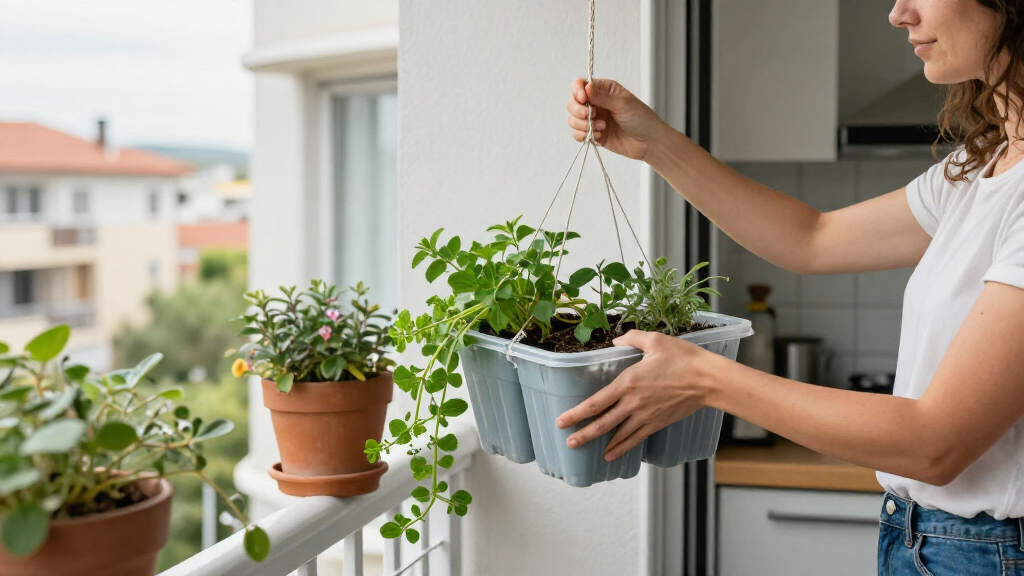
Gardener Smita Baruah has shown how to turn three discarded or spare plastic container lids into a tiered hanging planter, according to a project report by Hunker. The design uses small plant containers, drilled holes and jute string to display succulents vertically, offering a household reuse idea for people with limited shelf or counter space.
The project, shared on Instagram under the account smitasflair4creativity, uses three lids of similar size, a small circular container for each plant and jute string. Hunker describes the containers as roughly four ounces and the lids as similar to those used with 24-ounce food containers. Each lid serves as a horizontal tier, while the plant containers sit in openings cut at their centers.
To make the tiers, the instructions call for tracing a small pot around the center of each lid, cutting an opening that allows the pot rim to rest in place, and drilling four holes near the corners of every lid. The maker paints the lids and decorates the small pots with patterned paper and Mod Podge, then threads four lengths of jute through the aligned holes. Knots beneath each lid help hold the tiers in position.
Hunker’s materials list includes a craft blade, scissors, marker, small drill, primer, paint, varnish, decorative paper and Mod Podge, alongside the lids, pots and string. Once assembled, the planter can hold succulents or herbs, the report says. The design hangs from the connected strings, with the lids positioned bottom-side up as described in the instructions.
A Second Use for Container Lids
The project is a small-scale example of reusing household plastic rather than immediately discarding it. It also puts vertical space to work: several plants can be arranged in a narrow footprint instead of taking up separate spots on a counter or shelf. That may appeal to people looking for ways to display plants in smaller homes or near a kitchen workspace.
Hunker characterizes the approach as inexpensive and customizable, but the report does not give a project budget or compare its cost with store-bought planters. Its practical value depends on the condition and shape of the lids, the weight of the filled pots and how securely the structure is assembled. The project is best understood as a creative reuse idea, not a tested product or a claim that plastic waste is eliminated.
Products Worth Considering

Philips Hue Festavia Globe Outdoor String Lights, 32 Bulbs, 91 ft

Shark Navigator Robot Vacuum with Self-Empty Base, Dark Grey (RV2120AE)

Roborock Q7 M5+ Robot Vacuum and Mop with Self-Emptying Dock
As an affiliate, we earn on qualifying purchases.
How the Three-Tier Design Works
The design combines two functions of the reused lids. A central opening in each lid supports a small planting container, while holes at the corners allow the tiers to be linked by four lengths of jute. Matching the holes across all three lids is part of the assembly: uneven placement could leave the tiers crooked or put uneven tension on the string.
The decorative steps are optional to the basic structure. Hunker’s instructions describe applying primer and paint to the lids and pots, then attaching patterned paper to the pots with Mod Podge before painting their rims. The report presents the finished planter as suitable for succulents and suggests herbs as another possible use, including placing the hanger near a kitchen counter. It does not describe testing the arrangement with different plant types or watering routines.
“The planter can be used to show off succulents or to hold herbs near a kitchen countertop.”
— Hunker
Durability and Hanging Safety
The source does not state when Baruah posted the project, how long the planter has been in use or whether the lids and string were tested for a particular load. It also does not specify a recommended hanging location, maximum plant weight, watering method or whether the plastic is suitable for prolonged exposure to moisture or sunlight.
Those details matter because the completed planter holds water and soil above the floor, and the lids’ strength can vary by type and condition. Hunker’s report offers craft instructions, not a load rating or safety certification. Anyone making the project would need to judge the materials and hanging point for their own setup; the source does not establish that every plastic lid can safely support a planted container.
What Makers Should Check
No additional update, product release or follow-up test is identified in the report. For now, the development is a documented DIY project rather than a commercial planter or independently evaluated design. Readers following the original creator’s account may find further examples or guidance there, but Hunker’s article does not say whether Baruah has published additional instructions.
Before adapting the idea, makers can check that the lids are undamaged, the cut openings fit the pots securely, and the holes line up across tiers. The report does not specify a weight limit, so a finished hanger should not be treated as load-rated. How well it works in a particular home will depend on the materials, assembly and hanging surface.
Key Questions
Who created the hanging planter?
Smita Baruah, whose Instagram account is identified by Hunker as smitasflair4creativity, is credited with the DIY project.
What materials does the design use?
The reported design uses three plastic lids, three small plant containers and jute string. The decoration list includes primer, paint, patterned paper and Mod Podge; the instructions also call for tools to cut openings and drill holes.
Can the planter hold herbs?
Hunker says the design could be used for herbs as well as succulents, and suggests placing it near a kitchen counter. The report does not provide specific guidance on watering or plant care.
How much weight can the hanger support?
The source gives no weight limit or load test. Capacity may depend on the lids, string, knots, plant containers and the point used to hang the planter.
Source: rss