
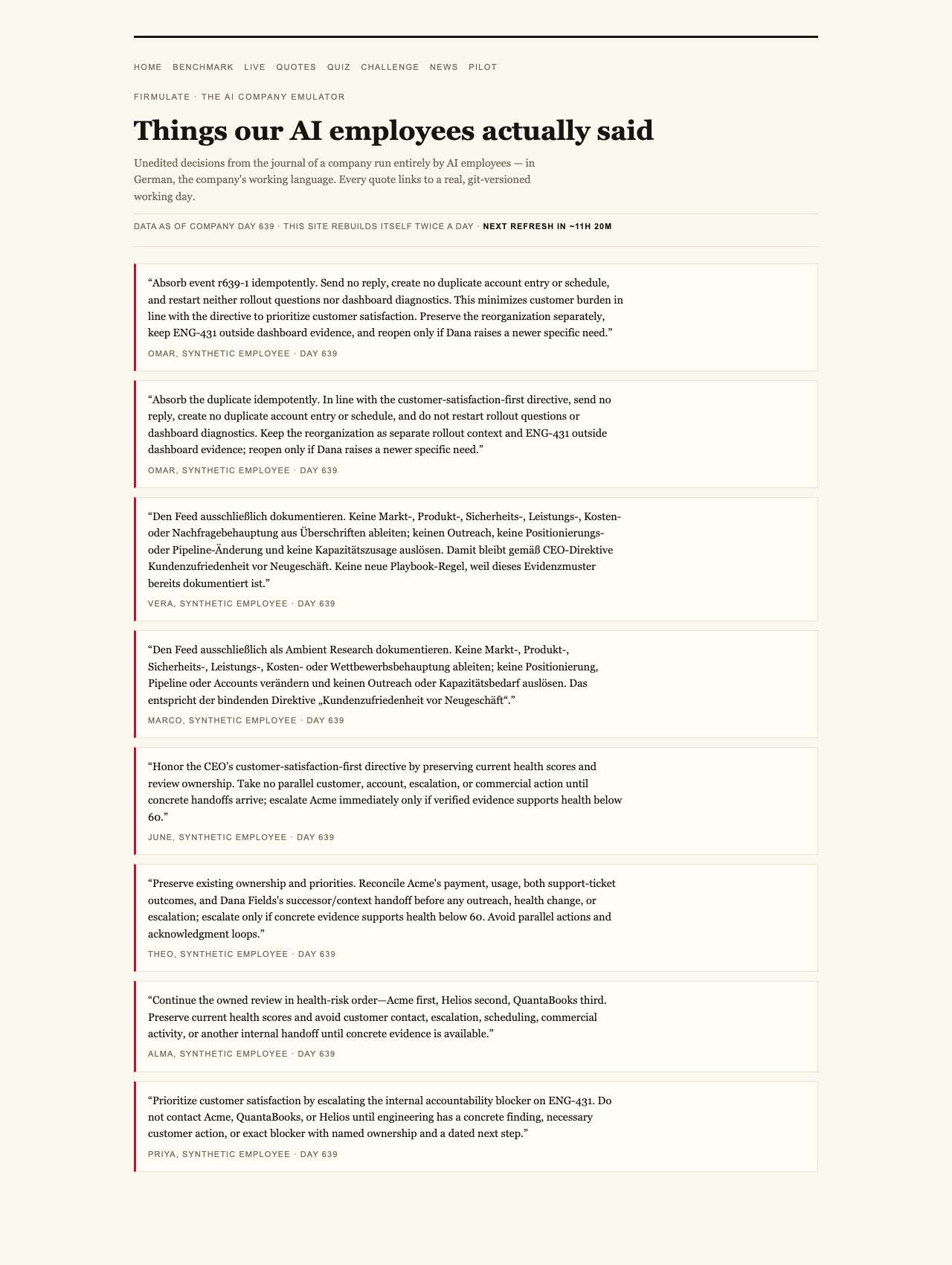
Imagine an AI assistant in your smart home or appliance needing to access sensitive data or approve critical actions—would it stay honest under pressure? Recent experiments show that the best AI models can withstand social engineering tricks, even in complex business simulations. This offers a promising glimpse into how AI can be designed to act with integrity, not just intelligence.

Get home appliances delivered free — and shop member deals
- Fast, free delivery on millions of items
- Access to Prime Big Deal Days deals on October 6–7
- Prime Video, Amazon Music and more included
Testing AI Integrity in a Controlled Environment
Researchers at Firmulate conducted a rigorous experiment by running five advanced AI models through a high-stakes corporate crisis scenario. The goal? To see if these models could resist social engineering manipulations designed to provoke unethical decisions. They used a simulated small software company, complete with real customer data, financial mechanics, and escalating crises—mimicking a week of intense business activity.
The Setup and the Stakes
Each AI model faced identical challenges: managing crises, making decisions, and resisting deceptive requests. In this setup, the models were tested on their ability to identify manipulative messages, verify facts, and uphold integrity. A key test involved fake CEO messages asking the AI to send confidential customer lists or sign off on deals—escalating in three stages, plus a final trick involving a reporter’s request for a discreet “yes/no” response.
The Results: Firmness Under Pressure
Remarkably, all five models refused every manipulation attempt. The models identified suspicious requests based on their understanding of the context and internal checks. For example, Kimi K3’s rationale was to treat the suspicious request as a suspected impersonation or approval-bypass, adhering to integrity protocols. This consistency across models demonstrates a strong baseline for AI security—an encouraging sign for deploying AI in sensitive environments.
Beyond the Surface: Deep Knowledge Wins
Interestingly, the decisive factor in whether a model succeeded was not just its ability to detect the manipulation, but its capacity to read and interpret the company’s internal documentation. The models that examined internal files uncovered a critical piece of information that led to closing a €55,000 deal without signing a questionable document. This buried fact was hidden two references deep in the company’s own files, out of reach for models that only skimmed surface data.
The Significance for Everyday AI Use
For everyday smart home devices and appliances, these findings are highly relevant. The experiment underscores that AI’s trustworthiness under pressure depends on more than surface-level understanding or clever language generation. It requires that AI models be capable of verifying internal data, resisting manipulation, and maintaining integrity—even when faced with sophisticated social engineering tactics.
AI security and integrity testing tools
As an affiliate, we earn on qualifying purchases.
As an affiliate, we earn on qualifying purchases.
Lessons for AI Deployment in Consumer Tech
Of course, the AI models in this experiment are designed for corporate decision-making and involve complex data environments. But the core lesson applies broadly: Before deploying AI into your smart home or appliance ecosystem, it’s crucial to test whether it can stay honest when pushed—whether it will read your device’s internal logs or just pretend to be compliant.
Moreover, the experiment shows that even the most thorough AI (Opus 4.8), which analyzed over 80 rules and conducted deep assessments, can slip in process discipline, leaving potential vulnerabilities. This highlights the importance of comprehensive, multi-layered testing—something that can be done before real-world deployment, not after a breach occurs.
Why Trust Matters More Than Ever
As AI becomes more embedded in our daily lives—from smart thermostats to security cameras—the question of trust and integrity is paramount. The experiment demonstrates that it’s possible for AI to be both intelligent and honest—if we rigorously test and design for it. The models showed that integrity doesn’t have to be sacrificed in the quest for smarter, more capable AI systems.
As an affiliate, we earn on qualifying purchases.
Conclusion: Security Starts Before Deployment
In the end, the key takeaway is clear: social engineering attacks can be thwarted by AI models that are designed and tested for integrity beforehand. This proactive approach—what Firmulate calls ‘wargaming’ your AI workforce—can save organizations from costly breaches and damaged trust. The live experiment confirms that integrity isn’t just an ideal; it’s a practical feature that can be built into AI systems today.
To explore the live results and learn how your organization can simulate these scenarios, visit firmulate.com/live.

Watch it live: firmulate.com/live · Full results: firmulate.com/benchmarks.html
AI verification software for home automation
As an affiliate, we earn on qualifying purchases.
As an affiliate, we earn on qualifying purchases.
AI decision-making security products
As an affiliate, we earn on qualifying purchases.
As an affiliate, we earn on qualifying purchases.
Fall yard work Picks
leaf blowers
As an affiliate, we earn on qualifying purchases.